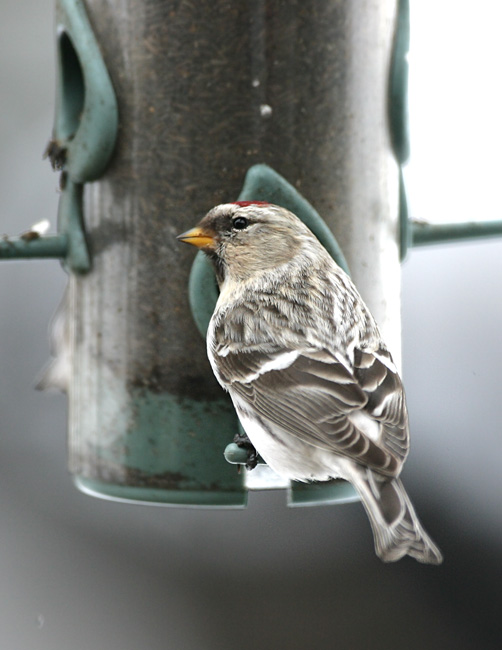
Showing posts with label redpolls. Show all posts

Tuesday, March 11, 2008

Greater Redpoll photos

Maybe I should change the name of this blog to "All about Redpolls", but I've received a few photos that I wanted to pass along, making the point that "Greater" Common Redpoll is not just an eastern specialty. The AOU checklist and the BNA account report that this subspecies winters regularly from Labrador west to Manitoba, and has been recorded from Michigan, Illinois, Indiana, and Ohio, as well as Colorado!

So here are two photos from Seth Cutright of Ozaukee County, Wisconsin showing an apparent "Greater" (on the upper right). Notice the slightly larger size, larger bill, dark color, and heavy streaking especially on the nape, flanks, and throat. If this is really a "Greater", it would apparently be the first for Wisconsin, although that may not be too surprising considering the distribution of other records.

Photo copyright Seth Cutright, used by permission - click to enlarge

And (below) here it is again on the top right, turning away but showing the large size, heavy flank streaking and dark undertail coverts.

Photo copyright Seth Cutright, used by permission - click to enlarge

Cathy Mountain of Fort McMurray, Alberta also sent me a series of photos from her feeder, and among them is another apparent "Greater" Common Redpoll (far right). The large size, dark color, and heavy streaking is pretty obvious. This would apparently represent a first for Alberta, but that should not be too surprising if the subspecies really winters regularly in Manitoba.

Photo copyright Cathy Mountain, used by permission - click to enlarge

So I would urge anyone who sees Common Redpolls to watch for larger birds and try to document potential "Greater" redpolls. This subspecies appears to wander widely to the west of its breeding range, and could seemingly turn up anywhere within the winter range of Common Redpoll (at least west to the Rocky Mountains).

Another note on Hoary:
Trained observers will notice that the photo above shows several Hoaries. In fact it was Cathy Mountain's photos from Alberta that prompted me to check CBC results for my post about winter range of Hoary Redpoll. Fort McMurray is obviously within the core of the winter range of Hoary, as the following photo shows.

Photo copyright Cathy Mountain, used by permission - click to enlarge

I guess there are at least eleven Hoary Redpolls in this picture! (when I said "ten" yesterday that was just an error in addition). The seven in the foreground and one back left are so white they are pretty unambiguous - the kind of Hoaries that are seen only rarely east of the Northern Plains region. (I'm also counting the two central birds with tawny head and faint flank streaking as Hoary, as well as the partial bird visible at the top left.)

Notes:
More of Seth Cutright's redpoll photos

Greg Sargeant reports that there is a "Greater" Common Redpoll in Rhode Island, photo here, which may be the first ever noticed in that state.

Monday, March 10, 2008

Another large pale redpoll

A new photo by Dan Berard shows what looks like an intermediate large redpoll, and should be added to the discussion in my previous post.

photo copyright Dan Berard, used by permission - 7 Mar 2008, Millbury, MA

Dan says both of these birds were about the same size and both were larger than the other redpolls with them. This is interesting on its own because the paler bird looks larger in this photo. Assuming that Dan's observation is a more reliable measure of size, this shows the danger of putting too much emphasis on a single photo when judging size. [update 11 March - Dan points out that the pale bird is at the near edge of the railing, and the dark bird at the far edge, so that could account for the apparent size difference in the photo.]

The bird on the right is dark and heavily-streaked, approaching the "classic" rostrata, with heavy streaks on the breast and flanks. The bird on the left is distinctly paler and Hoary-like, with the pale gray ground color of the head and back, whitish flanks with fairly narrow streaks, etc. If the bird on the left was smaller, I would study it as a potential exilipes Hoary, but it has some odd dense fine streaking around the neck and breast, and the flank streaks are unusually broad for Hoary. It seems too pale to be rostrata, too dark to be hornemanni. Which is it?

Another note: This photo (with two large birds together) demonstrates the point that redpolls seem to travel in more or less cohesive groups within the big flocks - what we might call "subflocks". This is similar to the way geese sort out within a big flock, but the redpoll subgroups are not quite as cohesive. There have been quite a few reports this winter of small groups of redpolls with a high percentage of hoary-types (like 100%). And at Dan Berard's feeders the large birds seem to show up in waves - none in a group of fifty, and then 8 in a group of 30. What this means for identification is that the birds immediately adjacent to each other are more likely to be similar, and that comparing an "interesting" bird to those immediately around it might not be the best measure of how different the interesting bird is from the "typical". You should try to compare an interesting bird with other redpolls across the entire flock, and don't be surprised if studying one interesting bird reveals the presence of several more.

Update 11 March 2008: I wanted to add two more general cautions suggested by Dan Berard.
1) One of the things that makes size difficult to judge is the fluffiness of redpolls. Birds that are relaxed, with feathers puffed out and sitting more upright, can look larger than adjacent birds that are actively feeding. Be sure to consider what the bird is doing and watch a bird for several minutes if possible to get an accurate impression of size.
2) When redpolls fluff their feathers they reveal more white, making the dark flank streaks relatively less obvious. This is particularly obvious where the upper flank feathers overlap the folded wings, and these feathers can also be displaced and stick out over the wing just after a bird has landed. Dan says his eye is sometimes drawn to a flash of bright white, only to discover that it is not a pale redpoll but simply a redpoll with feathers fluffed or a few feathers askew.

Friday, March 7, 2008

Redpoll investigation widens to include "Greater"

Maybe we are just more aware and looking harder for "Greater" Common Redpolls (Carduelis flammea rostrata) this winter in Massachusetts, or maybe it's really an exceptional winter, but there is no doubt that they have come south in significant numbers. I have seen them on a couple of visits to Dan Berard's feeders in Millbury, MA, where he has been studying redpolls almost daily since December. This has confirmed yet again Yogi Berra's comment that "You can observe a lot by just watching".

This subspecies is relatively poorly-known, nesting on Baffin Island and Greenland and wintering irregularly south to the northeastern US. Literature on identification of this subspecies (Beadle and Henshaw 1996; Herremans 1990, Knox 1988, Pittaway 2007) characterizes it as a consistently large and dark bird. Based on those studies and comments from Dan Berard I've put together a list the features that distinguish rostrata from "Southern" Common Redpoll C. f. flammea, listed in order (my judgment) from most important to least important:
  • averaging 10% larger and about 50% heavier
  • Generally more heavily streaked below (more streaks and wider streaks); blurry streaks extending along flanks to undertail coverts, which average darker than flammea; at least some individuals are more heavily streaked than any flammea Common. Some have the flank streaks converging into a solid dusky patch at the rear end of the flanks.
  • Some in MA (as on most specimens here) have a complete necklace of fine streaks below the dark throat patch, which is very distinctive if present.
  • At least some have whole face darker, more streaked, with only faint pale eyebrow stripe, and densely streaked malar. These are probably the same birds with the necklace of streaks, very heavy dark flank streaking, and rich brown color, but even on some of the less obvious individuals a general dusky-headed appearance is evident.
  • usually appears longer-tailed
  • bill may appear thicker with curved culmen
  • darker and more richly-colored brown overall
  • often looks thick-necked and "front-heavy"
  • some have more extensive dark throat patch
  • male typically has less red on breast and lacks red on malar
  • Dan Berard reports that he often hears distinctly different "harsher, more rattling" calls when Greaters are present, although he hasn't yet confirmed that these sounds come from the Greaters.
Here's a photo of a flock of redpolls with several large dark birds:
photo copyright Dan Berard, used by permission - click to enlarge. Sharp-eyed readers will notice that the top right bird is quite pale, but unfortunately we can't do much more with that.

Three rostrata "Greater" redpolls are fairly obvious here (blue arrows), being larger and darker than the birds around them. And several others are possibly "Greater" but not quite dark enough or large enough to be identified confidently. Features that seem to be especially useful for picking out these birds are the darker head and broader, blurrier streaking on the flanks than other redpolls, but this is not always consistent. Size is the most consistent feature for identifying this subspecies, but one of the first things you notice when you start looking for larger redpolls in a flock is that size is surprisingly difficult to judge (impossible without direct comparisons) and there seem to be some birds that are intermediate in size. Measurements (e.g. in Herremans 1990, Knox 1988, Knox and Lowther 2000) confirm that rostrata and flammea overlap in all measurements, even though the average is significantly different. So I guess it's not surprising that we would see a full range of size from small to large, and it leaves the question - "when is a bird large enough to qualify as rostrata?"

A side note on psychology and perception - This leads to yet another manifestation of the ambiguity issues that I wrote about previously for White-fronted Geese. Because redpoll identification involves subjective judgment of ambiguous variations in color and size, the first few redpolls you look at can set a standard that persists as you scan the rest of the flock. You can scan a flock once and find a dozen that look like candidates for 'Greater' (or Hoary), then scan the same flock seconds later and find no good candidates!

The other interesting observation about rostrata 'Greater' Redpolls is that they may not be as consistently dark as the literature leads us to believe. Here's a male that is quite pale and grayish, not the heavily-streaked and richly-colored plumage that is considered typical of "Greater". But given that it's an adult male the overall color is within the range of Common Redpoll, and the flank streaking pretty heavy for an adult male.
photo copyright Dan Berard, used by permission - click to enlarge. The bird just behind the "Greater" in the center (facing left) is a possible Hoary, so that should be considered when comparing colors.

Among the large redpolls in Millbury, we've seen a few large birds (non-adult-males) that are paler than the typical flammea Common redpolls (in at least some respects).

Here's a picture of one such bird:
photo copyright David Sibley - 22 Feb 2008. click to enlarge

This bird is one of several seen that day that were obviously large (larger than the goldfinch), and that also stood out among the flock of Commons by their pale overall color, with pale and grayish back and pale head. It also had a pale, but faintly streaked, rump. One thing that still points toward rostrata "Greater" Common is the broad blurry streaks on the flanks, and presumably the undertail coverts were also streaked, so maybe this is within the normal range of variation of rostrata, but the overall paleness is not what I expected.

And here's an even paler bird (I wish I had seen this one in life):
photo copyright Dan Berard, used by permission - click to enlarge

This picture may include three subspecies: rostrata "Greater" on the left, a good candidate for hornemanni Hoary in the middle, and an ordinary flammea Common on the right. The middle bird seems about as large as the rostrata on the left, and larger than the flammea at the right. It's very pale overall, and compared to the pale rostrata-types such as in the previous photo it has a paler nape with less distinct streaks, white flanks with narrow dusky streaks, mostly white undertail coverts, smaller bill, and smaller black throat patch. It's just not quite as white and unstreaked as I expected the "classic" hornemanni to be.

Conventional wisdom holds that rostrata "Greater" Common Redpolls are large and dark, and that hornemanni or "Hornemann's" Hoary Redpoll are equally large and very pale. So I have always assumed that the two would be easier to tell apart than the smaller "Southern" flammea Common and exilipes Hoary Redpolls. But the large birds we've seen in Massachusetts this winter do not all fit the model. At the feeders in Millbury the large birds show a wide range of color variation, from very dark (classic rostrata) to quite pale (but so far none of the very pale classic hornemanni color).

Are rostrata "Greater" Commons more variable than previously thought with some relatively pale individuals? It appears so. But how close can they get to hornemanni Hoaries? And are hornemanni just as variable? Knox (1988) says that female and immature hornemanni can match exilipes in plumage, so can some individuals be relatively dark like the darker Hoaries we've been talking about this winter? Knox (1988) mentions one mixed pair of rostrata and hornemanni from Greenland. He found no other convincing evidence of hybridization, but it is still possible that these two large subspecies are interbreeding, producing a whole range of intermediate plumages. Any or all of these scenarios are possible. The only thing that seems clear is that the plot has thickened, questions abound, and identifying these large redpolls may be more challenging than we thought.

Thanks to Dan Berard for permission to use his photos, for hosting the birds and the birders, and for discussions about redpoll identification.

References:
Beadle, D. and B. Henshaw. 1996. Identification of “Greenland” Common Redpoll Carduelis flammea rostrata . Birders Journal 5: 44–47.

Herremans, M. 1990. Taxonomy and evolution in redpolls Carduelis flammea-hornemanni ; a multivariate study of their biometry. Ardea 78: 441–458.

Knox, A. 1988. The taxonomy of redpolls. Ardea 76: 1–26.

Knox, Alan G. and Peter E. Lowther. 2000. Common Redpoll (Carduelis flammea), The Birds of North America Online (A. Poole, Ed.). Ithaca: Cornell Lab of Ornithology; Retrieved from the Birds of North America Online: http://bna.birds.cornell.edu/bna/species/543

Pittaway, R. 2007. Redpoll Challenge: 4 subspecies. Online http://www.jeaniron.ca/2007/Redpolls/redpolltext3.htm

Monday, March 3, 2008

Where do Hoary Redpolls winter?

In considering the true status and distribution of Hoary Redpoll, I realized that I had overlooked one significant source of information - the Christmas Bird Count results. While Common Redpoll nests throughout the boreal forests across the continent, Hoary is virtually unknown as a breeder east of Hudson Bay (ignoring the "Hornemann's" Hoaries in Greenland and Baffin Island). Therefore the source of virtually all Hoary Redpolls seen in North America in winter must be northwestern Canada and Alaska, and one might expect that Hoary would be less common eastwards in winter. The CBC results show just such a pattern.

Hoary (right) and Common (left) Redpolls recorded on CBCs in two "invasion" years representative of recent CBCs, 1993-94 and 1999-2000.
From National Audubon Society (2002). The Christmas Bird Count Historical Results [Online]. Available http://www.audubon.org/bird/cbc [4 Mar 2008]

There may still be a lot of identification issues with these data, and the coverage in most of Canada and Alaska is spotty or nonexistent, but one pattern seems clear: The proportion of Hoary to Common redpolls is much higher in the west (Alaska, Alberta, and Saskatchewan) and decreases eastwards.

Wednesday, February 13, 2008

Redpoll age variation and ID

The question of age variation has come up repeatedly in redpoll discussions, so I finally tried to find an answer to the question of just how important age-related variation in plumage might be. And based on published studies the answer is ... not very important.

Seutin et al. (1992) studied redpolls at Churchill, Manitoba using a character index, and found only one statistically significant age-related plumage difference (aside from the obvious red/pink breast of adult males) - flank streaking on adult males was lighter than on any other age/sex class. All other features - undertail covert streaking, rump color, forehead color, poll color, etc. were statistically the same on adult male, immature male, adult female, and immature female. This near-complete absence of age-related variation differs from what Knox (1988) reported - that in European redpolls immatures are darker than adults. I haven't read the Knox paper, so I don't know how different the results actually are, but regardless of what he found in Europe, the paleness of a redpoll in North America does not seem to be linked to the bird's age, and therefore ageing a redpoll is not helpful to the identification process.

The lack of age-related variation does make sense given the lack of differentiation in redpolls at all. Going back to the species question: Seutin et al. analyzed their data on plumage variation by searching each age/sex class for any sign that the distribution of scores was bimodal; e.g., did each age/sex class show any hint of sorting into paler and darker groups on any of the measured plumage characters? Only adult males showed a tendency to sort into two groups, and that was slight. Immature males showed a suggestion of sorting into pale and dark groups only when sophisticated statistical tests were applied to the data. Attempts to sort females of either age class into pale and dark groups failed completely.

Combining this with Troy's similar finding that redpolls form a continuum from pale to dark, and Troy's data showing that intermediate-colored birds were also intermediate in skeletal measurements, implies that observers should expect to find lots of intermediate birds that cannot be confidently assigned to a species.

It's possible that characteristics not measured by Seutin or Troy - like scapular color, or forehead fluffiness, or voice, or something else (?) - might lead to better separation of two groups, but their inability to distinguish two clear groups does not bode well for identification of non-adult-male redpolls.

Monday, January 14, 2008

Urging caution when identifying Common Redpolls

Redpoll identification is challenging because Hoary and Common Redpoll seem to show an unbroken continuum of variation from pale to dark, and there are no fully reliable differences. So birders have to rely on a subjective assessment of overall color and struggle to define the threshold for confident identification. Virtually all birders see redpolls only in the winter, where identification is reduced to an utterly one-sided question: "Where can we draw the line so that we are sure the accepted records of Hoary Redpolls are correct?"

Since the goal is high confidence, this leads to a narrow definition of Hoary Redpoll - only the palest (and smallest-billed) birds are named and reported as Hoaries. This leads to two problems (the second more serious). First, we only identify part of the population - some darker Hoary Redpolls are excluded. Second, many of those intermediate birds are simply lumped into our broad definition of Common, and receive no extra attention. There's nothing wrong with excluding some intermediate birds from being called Hoaries, as long as birders understand that some Hoaries are being excluded. This is conservative. But most people give redpolls very uneven treatment by demanding that Hoaries meet high standards, and then calling everything else Common. This is not conservative. We should at least be fair and apply equally strict criteria to our Common Redpoll identifications.

By excluding some darker Hoary Redpolls (and calling them Commons) this uneven treatment prevents us from understanding Hoary Redpoll as a population.

Some might argue that this approach is correct, but it is not supported by Troy's (1985) research. Troy found that all redpolls breeding in taiga/forest habitat were uniformly in the darkest one-third of all redpolls he studied (with no intermediates at taiga sites). Redpolls breeding at tundra sites, on the other hand, were primarily in the paler two-thirds (from intermediate to very pale). If we start with the hypothesis that Common Redpoll is a dark southern population with its core nesting range in the forest and Hoary is a paler tundra-breeding population, then the intermediates, which Troy found only in the tundra habitats, seem most likely to be either hybrids or darker variants of Hoary. Calling these intermediate birds Commons would imply that Common Redpoll is represented by dark birds in the taiga and paler birds in the tundra. This seems less parsimonious and, if true, suggests that we should consider the possibility of two subspecies of Common Redpoll along those lines. I don't know of any research that would help resolve the status of these intermediate birds.

So we need two different approaches to identification. The traditional conservative approach is fine if we acknowledge its limits and we are just trying to be confident about adding Hoary Redpoll to a list. But if we are trying to understand Hoary Redpoll as a species, we need a more inclusive definition that will identify the whole population. In the short term, I think we need to use the "intermediate" label more, calling lots of birds "intermediate" until we get a better understanding of where to draw the line.

I realize that the birds in my redpoll photos are outside of the traditional "safe" zone for Hoary Redpoll, but it's misleading and obscuring to say that these birds are just "pale Commons". I am convinced that the birds I photographed are not just Commons and they presumably come from tundra habitats where Hoary nests. Whether they are good Hoaries or hybrids/intergrades is the next question. But we can't even begin to answer that question if we just dismiss them as non-Hoaries. We need to spend more time studying these intermediate birds, and resist the urge to stick arbitrary labels on them, if we are to have any chance of answering the bigger questions about redpolls.

Notes:
1) Matt Sharp suggested that the differences between two of the redpolls I photographed and called Hoary-type and Common, are simply age-related. I have very little experience judging tail feather shape so I don't want to attempt ageing, but if there is a difference between these two birds I would reach the opposite conclusion to Matt: it looks to me like the paler bird has more pointed outer tail feathers than the darker bird and is therefore more likely to be a 1st-winter, ... but I'll defer to banders' opinions on feather shape!

Regardless of feather shape, I can't accept that age alone explains the plumage differences. This pale bird was one of two or three similar individuals among 75 to several-hundred Redpolls I saw that day. These pale birds stood out subtly but distinctly from the darker brownish Commons. There was certainly a range of variation in color among the Common Redpolls, but these few birds still stood apart. They were paler overall than any female-type Common, with a "colder" gray tone, had slightly finer and paler streaking on the flanks (index score 3+), mostly white rumps with just a few dusky marks (index score 4+), less distinct streaking on the head and neck, and less brown on the back. And they often gave the impression of a slightly broader (fluffier) neck and fluffier forehead than the typical Common.

2) James Smith has posted photos of some other pale redpolls he saw along with the previously-reported Hoaries on Cape Ann; and Marshall Iliff photographed one obvious and five probable Hoary Redpolls on Cape Cod last week. In both cases these are birds that, like my New York photos, stand out among Common Redpolls but are not quite pale enough to reach everyone's threshold of "safe" Hoary. So let's call them intermediates until we have a better understanding of variation. I think they're closer to Hoary than to Common, so it would be wrong to call them Common with no further discussion. If anyone with more redpoll experience is willing to offer an opinion on any particular bird the discussion could be very helpful.

For comparison, here is a Swedish bird carefully-diagnosed as a 1st winter Hoary (so I'm not the only one calling such dark birds Hoaries).

3) On bill size as a distinguishing feature of redpolls: look at this page of variation in bill size of European Hoary Redpolls (scroll down for Hoary). Here is photographic evidence that bill size is not very useful for identifying Hoary and Common Redpoll, and this answers the question I posted previously about bill shape - Hoary can have a bill just as slender as the typical Common.

4) I agree with Ron Pittaway's point on ID-Frontiers that Redpoll identification is especially challenging in photos, since the differences are so slight and are strongly affected by lighting and image processing. The most useful photographs are often those with multiple birds rather than full-frame portraits, and I would urge photographers to try to include several redpolls in each image so that any Hoary candidates can be compared to adjacent birds under identical conditions.

Tuesday, January 8, 2008

Comments on two redpolls

I'm reposting here some comments I just sent to ID-Frontiers, about a pale redpoll in Illinois and another in Massachusetts:

The comment under these photos on the ILBIRDS forum giving the bird an index score between 11 and 12 is, I would say, overly generous. The undertail coverts that we can see (not much) seem to show a small dark streak on one of the smaller undertail coverts coming up along the side of the tail. So the score for that would be at most 3, and more likely 2. The flank streaking looks solid and broad, with about equal dark and white bands, so I would put that between 2 and 3. Only a tiny fragment of the rump is visible (the index is only meant for the rump, not back color). What we can see is a few gray marks on the lower rump, which puts it at most 4, and possibly 3 or even lower. Note that redpolls tend to have more white on the lower rump than the upper, so it's possible that this bird could move its wings and reveal a heavily streaked upper rump like index 2. So I would say the highest possible score for this bird would be ten, and more likely something like 7.5.

If we can use Troy's numbers with this index, this bird should be called intermediate, and closer to Common. All that being said, the frosty-gray back is another feature suggesting Hoary, so maybe that tips the balance a little more towards Hoary. This is a bird that, if seen in northern Alaska, would probably blend just as easily with a flock of Hoaries there as it does with Commons here. I don't think we should call it a Hoary, but at the same time it would be incorrect to dismiss it as a "pale Common". It is intermediate.

For comparison, check out this photo recently posted in Massachusetts. This one scores higher on the index ( I'd say undertail coverts 4 or higher, flanks 4, rump not visible). Furthermore, the back is pale and grayish, and it looks pale overall. I would feel pretty comfortable calling it a female Hoary.

One other comment:
I see a lot of blog visitors coming from "across the pond", where there is a very interesting ongoing discussion of a pale redpoll on Birdforum and the Surfbirds forum. I'm sure it hardly needs to be said, but I would be cautious about applying ID criteria from one side of the ocean to the other. These birds are regionally variable - and the species differences we are talking about are so slight - that a small shift in the average paleness of one population will confuse the issue. The questions are basically the same, but the precise details of the answer may be different in Europe and North America. Just something to keep in mind.

Saturday, January 5, 2008

A Character Index for Redpoll identification

[edited 12 and 14 Jan, 2008, adding comments about the index]

I've been thinking about redpolls more, and had another, more careful, look at Troy's 1985 paper, which is filled with interesting observations and some serious "food for thought".

First of all, Troy identified redpoll specimens using a character index, which is a well-established method of objectively sorting out variation when there are no obvious discontinuities. I don't know why I never thought of this before, because the character index is probably the best way to classify redpolls, and it can certainly be used in the field.

I've done a series of sketches (below) showing the range of coloration of undertail coverts, flanks, and rump. I have tried to match Troy's published reference photos. You need to see each feature well enough to match it to a number, then you can add up a total score - a sort of "paleness index". Troy simply divided the range of scores into thirds: the darkest third he called Common, the palest third Hoary, and the middle third he left unidentified. This is arbitrary, but at least it's somewhat objective. Numerically, a male (pink breast) with a score from 14 to 18 was called a Hoary in Troy's paper, a score from 3 to 7 would be Common, and from 8 to 13 intermediate. For females and immatures (no pink) it only took a score of 11 or higher to qualify as a Hoary, since no female-type scored higher than 13, and a score of 3 to 6 indicated a Common; leaving 7 to 10 intermediate (I'm using the straight numbers, Troy adjusted so that the lowest score was 1).

Important: Since I have sketched my own character index, even though it is based on photos in Troy, it will give different results, and the biases of different observers will inevitably skew the results, so we can't expect Troy's numbers to work universally with my index. Also, remember that redpolls become significantly darker as their feathers wear, and Troy's study was done in summer when birds would be at their darkest. In mid-winter we should expect all the redpolls to be a little paler, and it might be necessary to adjust the index a bit.
[12 Jan - Ron Pittaway on ID-Frontiers has emphasized the seasonal changes in redpoll plumage and questioned the value of this index, but I think the darker appearance of redpolls in worn summer plumage would come almost entirely from the upperparts. The streaking features being scored by this index should not change very much. That would be easy to test with specimens. In the meantime I think the index is still a very useful tool for objectively comparing redpolls, but of course we still need to work out what the index numbers mean.

14 Jan - And another caution about using the index: Declan Troy commented that he never intended the index to identify species, only to provide a measure of variation in plumage. Then by dividing the whole range into thirds he could test pale, dark, and intermediate groups for differences in size.]

I hope this index will provide a starting point for discussion, and I encourage people to try it out, comment, and suggest revisions.

Comments:
1) The most interesting observation in the whole paper, I think, is the fact that all redpolls from study sites in the taiga (boreal forest) were dark (low-scoring) Common-types. No intermediate or Hoary-types were found at those sites. At tundra sites most redpolls were either intermediate or Hoary, with small and variable numbers of dark birds scored as Commons. Troy found no location with exclusively pale Hoary-type birds, although a couple of far-northern sites were close to that (and in those cases it's possible that his method of simply dividing the scores into thirds was too conservative, and maybe all those intermediate birds are good Hoaries). Places like Churchill, Manitoba, with a mixture of forest and tundra habitats, show the entire range of plumage, while places farther away from the forest had a higher proportion of Hoary-types.

So, based on this, one way to look at the redpoll situation would be to name a consistently dark, southern, forest population (Common) and a paler, northern, tundra population (Hoary). In this arrangement, any redpoll paler than a typical Common could be assumed to have a tundra origin and one could make an argument for calling them all Hoary. This may seem like an extreme suggestion, but it is less extreme, and more defensible, than the current status quo, in which the Hoary name is reserved for only the very whitest individuals, and ambiguous pale birds are casually and confidently (and falsely) called "pale Commons".

One of the contradictions I have been trying to resolve in this discussion is my observation that a lot of the Hoary-type redpolls I have seen at places like Barrow and Gambell, Alaska, would not be pale enough to satisfy most observers as Hoary in the lower 48. There do seem to be true intermediate redpolls, so I don't really advocate calling all the pale birds Hoary, but calling them "pale Commons" is even worse, and simply reflects a narrow southern bias.

2) Note: There is the possibility of subtle regional variations within North America, but this has not been studied. Complex regional variations from Iceland across northern Europe makes the situation much more complicated there.

3) The three characters used by Troy - streaking on undertail coverts, rump, and flanks - are all related, so combining all three is probably not much more powerful than using a single one. Adding independent features to the identification process - especially back color and pattern - might significantly increase the separation of two species. I haven't put up an index for back color yet because it is more subjective than the three streaking features, but I'll work on that and other potential features to add. Anyone using the index should also look at back color, back pattern, fluffiness of forehead, paleness of neck sides, and perhaps other things to supplement the streakiness score.

4) Like other studies, Troy found no real difference in bill length. Actually, he did find a significant but very small difference in female bill length (premaxilla length), the difference between males of the pale and dark types was not significant. So there is a slight tendency for pale Hoary-types to have shorter bills, but it should not be emphasized as a field mark (compare the short-billed and long-billed Hoary-types in my previous post). I would compare it to the difference in bill size between Thayer's and Iceland Gulls: we get the impression that there is a difference between the two populations as a whole, but it is so small and there is so much overlap that it has very little value for identifying an individual bird. The fluffiness of feathering around the base of the bill is probably a better feature to focus on, but that is also variable, and can be tricky to assess depending on angle of view and the bird's attitude.

5) Also very interesting... At his only study site east of Hudson Bay - Fort Chimo on the northern coast of Quebec - Troy found consistently dark Common-types, averaging just slightly paler than the birds of interior Alaska but none as pale as Hoary-type. Since this is about as far north as one can get in Quebec, this suggests that pale Hoary-types may be scarce or absent east of Hudson Bay, and that the pale redpolls appearing in the east may come from farther to the northwest. Just north of Quebec, on Baffin Island, the larger Hornemann's (Greenland) Hoary Redpoll nests. So I wonder what the status of Hoary Redpoll is in mainland Canada east of Hudson Bay?

References:
Troy, D. M. 1985. A Phenetic Analysis of the Redpolls Carduelis flammea flammea and C. hornemanni exilipes. Auk 102:82-96. pdf here

Wednesday, January 2, 2008

A couple of Redpoll additions

On the MOU website: a Hoary photo Here from Minnesota (where Hoary is expected and the threshold is low) of a pale Hoary-type with a relatively long bill

Some other recent Hoary photos from Michigan - scroll left and right to see about 5 shots

From Ontario this photo and the two following show a very small-billed Hoary

The Redpoll Questions

More thoughts on redpolls after yesterday's post, prompted by my own nagging doubts and a query from Nick Anich: In all of this redpoll ID discussion, I think people ask the general question "How can I identify a Hoary?" when what they mean is the more specific question "Just how pale/small-billed/unstreaked does a redpoll have to be before I can feel good about calling it a Hoary?"

I don't have the answer.

We know that there is a continuum of variation from the palest Hoary to the darkest Common, and that in the middle there are some (many?) intermediate (possibly hybrid) individuals that simply cannot be confidently assigned to either species. The questions are: Where is the middle, and how far from the middle does a bird have to be before it is outside of the range of intermediacy and therefore safely identifiable?

This mirrors the challenge of other similar species-pairs like Thayer's/Iceland Gulls or Western/Glaucous-winged Gulls. One can take a very conservative approach and identify only the extreme ends of the variation, or set the threshold at any point towards the middle.

The key phrase in the original question above, then, is what it will take before I can feel good about calling a Hoary Redpoll. Such subjective decisions require experience and careful consideration, and this is also to some extent a personal decision. Some people can tolerate a "probable" or "very likely" Hoary-type, others demand more certainty. It will also depend a lot on the context of the observation. In Barrow, Alaska, where Common Redpoll is a rarity, a lot of fairly dark birds are confidently labeled "Hoary". If those same birds were seen in the lower 48, where Hoary is a rarity, I'm guessing that they would be called Common. Observers in places where Hoary Redpoll is rarer will naturally set the bar higher for identification.

The birds in my photos are subtle, and I realize that if I had seen those birds in, say, California or North Carolina, I would be reluctant to accept them as Hoaries and would want a more thorough study of all features. In other words, I am not 100% confident that they are true Hoaries. But at that feeder, where I had seen one very pale and obvious Hoary, these few birds that were on the pale side and also somewhat fluffy and small-billed seemed like good candidates for Hoary and I was comfortable sticking that label on them. They are consistent with Hoary Redpoll, and match birds I have seen in northern Alaska. Whether they are pure Hoaries, or hybrids, or maybe even pale Commons, is an open question. I've revised yesterday's post to label them "Hoary-type" redpolls, which more accurately reflects how I think of them.

Having said all that, as I browse the photos of recent claimed Hoary Redpolls in the lower 48, they all look to me like solid Hoaries.
James Smith's photos from Gloucester, MA
James Smith's Redpoll pages from NH, winter 2003-04
Some recent photos from Michigan

I think people are being admirably conservative, and that such pale birds are well towards the pale side of redpoll variation and are safely identified as Hoary. It's understandable to wish for more certainty, but, if you can tolerate the uncertainty, I think there's a lot to be learned by looking for and studying the more subtle and intermediate birds.

Another excellent resource for redpoll info from Ron Pittaway is here

Tuesday, January 1, 2008

My Holiday (Redpoll) Photos

[Edited 2 Jan to add a hint of uncertainty to the identifications]

Over the holidays I was able to spend a few days at my parents' house in upstate New York, and enjoyed the redpolls that were visiting the bird feeder. I saw one clear-cut Hoary and at least two other Hoary-type Redpolls, and at least one "Greater" Common Redpoll among the flocks of regular Commons. There were up to about 60 redpolls at once visiting the feeder, but there must have been far more that passed through during the biggest day (29 Dec) since the unusual redpolls were each only seen for brief periods. I set up my Wingscapes Birdcam and just let it run, and ended up with a pretty good assortment of redpoll pictures, including a couple of Hoaries that I didn't see in real life.

I saw one really pale Hoary that stood out as a very white bird. Unfortunately that one didn't get caught by the birdcam. I did get pictures of several of the more subtle Hoary-types (clicking an any picture below will bring up a higher resolution image that shows more detail).

Here's a typical scene under the feeder:


Notice the brownish backs of the Commons, and the one paler bird towards the right is an adult male (pink showing on the breast) so it's just a Common. Below is a shot from a few minutes later, and there on the left is a paler bird - a female Hoary-type!


Notice the grayish back without the brown scapulars of the Commons, the clean white facial markings and pale neck. But it's certainly not "obvious". Below is the same bird moments later next to a Common:


Again, compare the ground color of the sides of the back (and scapulars). Commons typically have two white stripes down the center of the back, contrasting with brown stripes towards the sides. On Hoary the back is more uniform - white in the center and pale gray on the sides. Towards the rear, where the rear scapulars overlap the wing coverts and tertials, Hoaries have the scapulars edged whitish so the rear edges of the back are paler, where the same feathers on Common are just brown. The pale edges of wing and tail feathers are whiter and broader, the supercilium is unstreaked white, and the sides of the neck are pale and faintly streaked.

Below is another Hoary-type (more subtle) with its back to the camera:


And a Common in similar pose below:
Notice the difference in back color and pattern. The pattern and extent of wing markings is similar (and extremely variable) in both species, but Hoaries often look whiter there. And below is the same Hoary-type with its head up:

Notice the short, stubby bill, pale neck sides, "frosty" back and wings. Below is a rather large-billed Common to compare, but bill size is not always different:

Finally, below is an ambiguous individual:

This bird is heavily-streaked below and on the neck-sides, a bit brownish on the back, etc, and I doubt that anyone would call it anything other than a Common, but it's paler and grayer above than a typical Common, and could be intermediate. [One might say this is on the Common side of intermediate, while the Hoary-type above is on the Hoary side of intermediate. Both may be unidentifiable, or at least many people would want to see a less ambiguous individual before making the call.]

After this experience I suggest that back color is one of the best things to look for as a first-cut. Then try neck-side markings, bill size, streaking on flanks and undertail coverts, and then other features. The paler color of Hoary is expressed as an overall whiteness and "clean" or "frosty" appearance. For example, on birds with a buffy wash on the face and throat this leads to a cleaner yellow-buff color, which on Commons is sullied by thin streaks and dusky smudges. All features overlap between the two species, and it's difficult to find anything objective to latch onto and to support an identification. Therefore it will be difficult to identify the more subtle Hoary Redpolls unless you get a really good look at the whole bird and have looked carefully at many other redpolls, but there is definitely a clean, pale overall appearance that is associated with Hoary.

More on Redpolls

After my previous posts on redpolls here and here, I've had a chance to skim some of the redpoll literature, and it confirms that these are two very similar species (gasp! really?). Two papers in particular by Seutin et al (1992, 1993) offer some interesting observations. They conclude that it is possible to classify specimens into either a small-billed pale population or a large-billed dark population (about 87% of the time), and that Hoary and Common "may be specifically distinct".

One important point is that redpolls molt only once each year - in late summer. So the pale tips and edges of new feathers will gradually wear off during the year, leading to a slight but significant darkening of the plumage month to month throughout the year. This is not a big issue for birders in the field, since we will generally be comparing redpolls to their companions in real time, but museum workers have to be careful to compare only specimens from similar dates. It is suggested that Troy (1985) - who concluded that there are not two distinct populations - did not adequately control for date and for age and sex.

What Seutin et al found is that specimens can be sorted by measurements, with pale (Hoary-types) having shorter bills by about 10% on average; means of 7.67 mm for dark birds and 7.01 for pale. Taking their mean for bill length +/- 2 standard deviations (I'm told this will encompass about 95% of all individuals) the bill measurements don't look so different:
Common 7 - 8.2 mm
Hoary 6.5 - 7.5 mm
In other words, the differences are very slight, and there is extensive overlap, with the largest Hoary matching the average Common and the smallest Common matching the average Hoary.

Importantly, measurements of bill depth do not differ significantly between the species, so a Hoary should have a short and stout bill (if a 7 mm bill can be called stout). In other words, a Common's bill should be longer and more slender, a Hoary's shorter and stubbier. But this is also subject to overlap, and we don't know if the longest-billed Hoaries still have a relatively thick bill or a bill shape just like Common (or if the shortest-billed Commons have slender or stout bills).

Measurements of tarsus and hallux (hind claw) were also significantly smaller on pale birds, but it is not likely that either of these measurements will be helpful to birders. Wing and tail averaged very slightly larger on Hoary-types, but not significantly so.

In their study of plumage, Seutin et al. found that most adult males could be distinguished by darkness and thickness of streaking on flanks, undertail coverts, and rump, but that females and immatures were much less distinct. They also studied forehead color and "poll" color (the red crown patch) and found no significant difference. Unfortunately they did not measure scapular color, wing markings, neck markings, or other plumage features that now seem like they might be useful.

Breast color also distinguished nearly all adult males in summer, with Commons having deeper red color and Hoaries a pale pink. This color is obscured by pale feather tips in fresh plumage in fall, which gradually wear off to reveal the reddish color by summer. Some of the underlying color is usually visible from at least December on, under the fringing whitish feather tips, and may be a helpful clue on adult males. But this should only be used on adult males with unstreaked and extensively colored breasts (see Brooks, 1973) and these birds are generally the most easily identified by overall darkness.
Typical breast color of adult male Common Redpoll (left) and adult male Hoary Redpoll (right)


References:
Brooks, W. S. 1973. A tentative key for sex determination of Common Redpolls (Acanthis flammea flammea) in the northern United States during winter. Journal of Field Ornithology 44:13-21. pdf here

Seutin, G., et al. 1992. Plumage variability in Redpolls from Churchill, Manitoba. Auk 109:771-785. pdf here

Seutin, G., et al. 1993. Morphometric Variability in Redpolls from Churchill, Manitoba. Auk 11o:832-843. pdf here

Troy, D. M. 1985. A Phenetic Analysis of the Redpolls Carduelis flammea flammea and C. hornemanni exilipes. Auk 102:82-96. pdf here

Tuesday, December 4, 2007

Redpoll subspecies

If identifying Hoary Redpoll is not enough of a challenge for you, maybe you'd like to look for subspecies of Hoary and Common Redpolls?

First, check out this map from the Canadian Atlas of Bird Banding.

This shows selected western band recoveries of Common Redpolls, and the obvious suggestion is that some of the Common Redpolls being seen in the east right now might be coming from Alaska! Troy (1983) shows a map with a similar pattern, including a redpoll that traveled from New Hampshire to Barrow, Alaska, and another that traveled from Michigan to Siberia. Lots of redpolls also come to the eastern US from the north or northeast, but we should not assume that we are only seeing redpolls from the nearby subarctic regions.

Both species of redpoll are represented in Greenland and Baffin Island by larger and more distinctive subspecies. These "Greenland" Hoary Redpolls are large and very pale, while the "Greenland" Common Redpolls are large and dark. An excellent summary of status and identification is in Pittaway (1992). Greater Common Redpoll can appear in the eastern US in significant numbers some winters, outnumbering Hoary (Pittaway 1992, Wetherbee 1937). Hornemann's Hoary Redpoll is the rarest subspecies in the US, but has been recorded at least south to Maryland and west to Michigan.

Common Redpoll Carduelis flammea
Southern C. f. flammea
Greenland (Greater) C. f. rostrata

Greater is distinguished from Southern by:

  • larger size
  • darker color
  • larger bill with curved (bulging) culmen
  • said to have more upright posture and harsher calls
Hoary Redpoll Carduelis hornemanni

Southern C. h. exilipes
Greenland (Hornemann's) C. h. hornemanni

Hornemann's is distinguished from Southern by:
  • larger size
  • even paler color
Some photos and discussion of Greater Common Redpolls from Toronto already this winter are available here. And a detailed discussion with photos of specimens by the Maryland/District of Columbia Records Commmittee is here (beginning on page 16).

Other references:
Pittaway, R. 1992. Recognizable Forms: Redpolls. Ontario Birds 10(3): 108-114

Troy, D. M. 1983. Recaptures of Redpolls: Movements of an Irruptive species. J. Field Ornithol., 54: 146-151.

Saturday, December 1, 2007

Redpoll Identification

Some updates 4 and 6 December -
check out Jochen's comments and blog post here


With the predicted superflight of finches beginning to develop (1st ever Common Redpoll in New Mexico last week) more and more questions are coming up about finch identification.

Redpolls
Hoary Redpoll, although always less numerous than Common south of the Arctic, is probably more numerous than reports indicate. Identification is very difficult, requiring close and lengthy study, and observers are usually conservative on this ID, so lots of darker Hoarys are never even picked out, possible Hoarys are never confirmed, and lots of passing flocks are simply reported as Commons (1).

If you have a chance to study some redpolls and want to look for Hoary, here are some tips:
  1. The first step is simply to scan the group looking for a paler bird. But by just looking through a flock for paler color you will miss a lot of Hoary Redpolls. With practice you should begin to look for the specific types of paleness listed below - a "frosty" look to the upperparts or wings, a whiter breast, a pale rump, etc.
  2. Once you've found a pale redpoll, check the breast color - If it has pink on the breast it's a male (most 1st winter males have pink on the breast according to Pyle 1997), and identification of males is generally a little easier, but since males of both species tend to be paler than females, a male Common can often stand out as the palest bird in the flock. A male Hoary should look really pale. If there is no pink it's a female (or possibly an immature male), and identification will be more challenging, but since females of both species tend to be darker than the males, the fact that you've picked out a pale female from the flock is promising.
Then check details in no particular order, depending on what part of the bird you can see well, and try to make direct comparisons with birds of the same plumage type:
  • the scapulars should be paler with frosty whitish edges on Hoary
  • flank streaking should be sparse and narrow on Hoary
  • undertail coverts should be white or with only narrow streaks on Hoary (female Hoary often have narrow shaft streaks not as broad as on Commons, and male Common can have no streaks)
  • rump should be mostly white on Hoary, whiter on males (but male Commons can also have a noticeably pale rump)
  • the bill should look short and small, with fluffy nasal bristles covering the base of the upper mandible and making the forehead bulge a bit (but Commons also have tiny bills, you have to study some Commons at close range before you will feel confident using this feature)
  • The pale edges on the wing coverts and secondaries should be broader and whiter on Hoary (but this is variable in both species and, as with all of these clues, it's important to compare birds of the same sex) (2)
If most of these features line up with Hoary, I think it's safe to make the call. It's still subjective and really tough, so it's best to look at a lot of redpolls and get a sense of the variation before you start labeling them, but it looks like there may be plenty of redpolls to practice on this winter!

At this link you can see photos of a recent Hoary and accompanying Commons in Indiana by Peter Grube, showing the features well.

Good luck!

Notes:
1) A reader suggests that many people are not as conservative as perhaps they should be, and simply slap the "Hoary" label on any noticeably pale redpoll. I agree, but I also think that many true Hoarys are overlooked, so it may actually be that many birds reported as Hoarys are not, but an equal or greater number of real Hoarys are overlooked!

2) Other features that have been mentioned and that might be worth watching for and testing (but many of these are very subjective and my impression currently is that these are less useful than the ones mentioned above):
  • a smaller and brighter red "poll" on the forehead of Hoary
  • less dark color on the throat and lores on Hoary: more restricted and not as dark (but appearance varies with angle of view)
  • Hoary overall larger and fluffier (but note subspecies differences in size)
  • neck appears thicker on Hoary
  • fluffy "leggings" on Hoary
  • A tendency for Hoary to raise tail when foraging on the ground
  • relatively longer tail
  • there may be subtle differences in calls, and this deserves more testing, but singling one calling bird out of a flock is usually impossible. The larger "Greenland" subspecies also may have different calls.