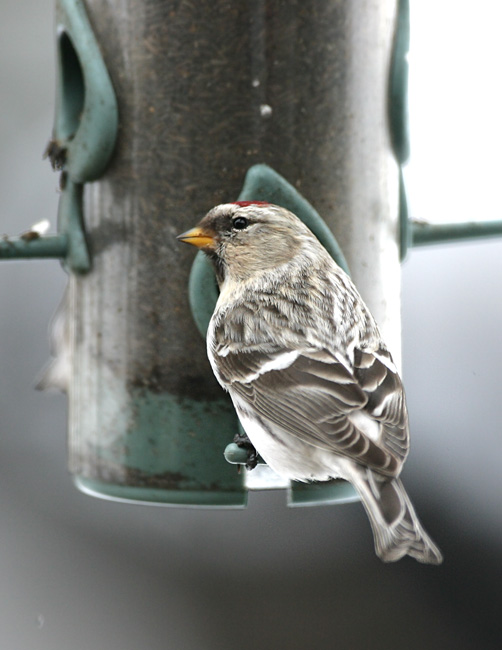
Redpoll identification is challenging because Hoary and Common Redpoll seem to show an unbroken continuum of variation from pale to dark, and there are no fully reliable differences. So birders have to rely on a subjective assessment of overall color and struggle to define the threshold for confident identification. Virtually all birders see redpolls only in the winter, where identification is reduced to an utterly one-sided question: "Where can we draw the line so that we are sure the accepted records of Hoary Redpolls are correct?"
Since the goal is high confidence, this leads to a narrow definition of Hoary Redpoll - only the palest (and smallest-billed) birds are named and reported as Hoaries. This leads to two problems (the second more serious). First, we only identify part of the population - some darker Hoary Redpolls are excluded. Second, many of those intermediate birds are simply lumped into our broad definition of Common, and receive no extra attention. There's nothing wrong with excluding some intermediate birds from being called Hoaries, as long as birders understand that some Hoaries are being excluded. This is conservative. But most people give redpolls very uneven treatment by demanding that Hoaries meet high standards, and then calling everything else Common. This is not conservative. We should at least be fair and apply equally strict criteria to our Common Redpoll identifications.
By excluding some darker Hoary Redpolls (and calling them Commons) this uneven treatment prevents us from understanding Hoary Redpoll as a population.
Some might argue that this approach is correct, but it is not supported by Troy's (1985) research. Troy found that all redpolls breeding in taiga/forest habitat were uniformly in the darkest one-third of all redpolls he studied (with no intermediates at taiga sites). Redpolls breeding at tundra sites, on the other hand, were primarily in the paler two-thirds (from intermediate to very pale). If we start with the hypothesis that Common Redpoll is a dark southern population with its core nesting range in the forest and Hoary is a paler tundra-breeding population, then the intermediates, which Troy found only in the tundra habitats, seem most likely to be either hybrids or darker variants of Hoary. Calling these intermediate birds Commons would imply that Common Redpoll is represented by dark birds in the taiga and paler birds in the tundra. This seems less parsimonious and, if true, suggests that we should consider the possibility of two subspecies of Common Redpoll along those lines. I don't know of any research that would help resolve the status of these intermediate birds.
So we need two different approaches to identification. The traditional conservative approach is fine if we acknowledge its limits and we are just trying to be confident about adding Hoary Redpoll to a list. But if we are trying to understand Hoary Redpoll as a species, we need a more inclusive definition that will identify the whole population. In the short term, I think we need to use the "intermediate" label more, calling lots of birds "intermediate" until we get a better understanding of where to draw the line.
I realize that the birds in my redpoll photos are outside of the traditional "safe" zone for Hoary Redpoll, but it's misleading and obscuring to say that these birds are just "pale Commons". I am convinced that the birds I photographed are not just Commons and they presumably come from tundra habitats where Hoary nests. Whether they are good Hoaries or hybrids/intergrades is the next question. But we can't even begin to answer that question if we just dismiss them as non-Hoaries. We need to spend more time studying these intermediate birds, and resist the urge to stick arbitrary labels on them, if we are to have any chance of answering the bigger questions about redpolls.
Notes:
1) Matt Sharp suggested that the differences between two of the redpolls I photographed and called Hoary-type and Common, are simply age-related. I have very little experience judging tail feather shape so I don't want to attempt ageing, but if there is a difference between these two birds I would reach the opposite conclusion to Matt: it looks to me like the paler bird has more pointed outer tail feathers than the darker bird and is therefore more likely to be a 1st-winter, ... but I'll defer to banders' opinions on feather shape!
Regardless of feather shape, I can't accept that age alone explains the plumage differences. This pale bird was one of two or three similar individuals among 75 to several-hundred Redpolls I saw that day. These pale birds stood out subtly but distinctly from the darker brownish Commons. There was certainly a range of variation in color among the Common Redpolls, but these few birds still stood apart. They were paler overall than any female-type Common, with a "colder" gray tone, had slightly finer and paler streaking on the flanks (index score 3+), mostly white rumps with just a few dusky marks (index score 4+), less distinct streaking on the head and neck, and less brown on the back. And they often gave the impression of a slightly broader (fluffier) neck and fluffier forehead than the typical Common.
2) James Smith has posted photos of some other pale redpolls he saw along with the previously-reported Hoaries on Cape Ann; and Marshall Iliff photographed one obvious and five probable Hoary Redpolls on Cape Cod last week. In both cases these are birds that, like my New York photos, stand out among Common Redpolls but are not quite pale enough to reach everyone's threshold of "safe" Hoary. So let's call them intermediates until we have a better understanding of variation. I think they're closer to Hoary than to Common, so it would be wrong to call them Common with no further discussion. If anyone with more redpoll experience is willing to offer an opinion on any particular bird the discussion could be very helpful.
For comparison, here is a Swedish bird carefully-diagnosed as a 1st winter Hoary (so I'm not the only one calling such dark birds Hoaries).
3) On bill size as a distinguishing feature of redpolls: look at this page of variation in bill size of European Hoary Redpolls (scroll down for Hoary). Here is photographic evidence that bill size is not very useful for identifying Hoary and Common Redpoll, and this answers the question I posted previously about bill shape - Hoary can have a bill just as slender as the typical Common.
4) I agree with Ron Pittaway's point on ID-Frontiers that Redpoll identification is especially challenging in photos, since the differences are so slight and are strongly affected by lighting and image processing. The most useful photographs are often those with multiple birds rather than full-frame portraits, and I would urge photographers to try to include several redpolls in each image so that any Hoary candidates can be compared to adjacent birds under identical conditions.
Monday, January 14, 2008


Tuesday, January 8, 2008
Comments on two redpolls
I'm reposting here some comments I just sent to ID-Frontiers, about a pale redpoll in Illinois and another in Massachusetts:
One other comment:
I see a lot of blog visitors coming from "across the pond", where there is a very interesting ongoing discussion of a pale redpoll on Birdforum and the Surfbirds forum. I'm sure it hardly needs to be said, but I would be cautious about applying ID criteria from one side of the ocean to the other. These birds are regionally variable - and the species differences we are talking about are so slight - that a small shift in the average paleness of one population will confuse the issue. The questions are basically the same, but the precise details of the answer may be different in Europe and North America. Just something to keep in mind.
The comment under these photos on the ILBIRDS forum giving the bird an index score between 11 and 12 is, I would say, overly generous. The undertail coverts that we can see (not much) seem to show a small dark streak on one of the smaller undertail coverts coming up along the side of the tail. So the score for that would be at most 3, and more likely 2. The flank streaking looks solid and broad, with about equal dark and white bands, so I would put that between 2 and 3. Only a tiny fragment of the rump is visible (the index is only meant for the rump, not back color). What we can see is a few gray marks on the lower rump, which puts it at most 4, and possibly 3 or even lower. Note that redpolls tend to have more white on the lower rump than the upper, so it's possible that this bird could move its wings and reveal a heavily streaked upper rump like index 2. So I would say the highest possible score for this bird would be ten, and more likely something like 7.5.
If we can use Troy's numbers with this index, this bird should be called intermediate, and closer to Common. All that being said, the frosty-gray back is another feature suggesting Hoary, so maybe that tips the balance a little more towards Hoary. This is a bird that, if seen in northern Alaska, would probably blend just as easily with a flock of Hoaries there as it does with Commons here. I don't think we should call it a Hoary, but at the same time it would be incorrect to dismiss it as a "pale Common". It is intermediate.
For comparison, check out this photo recently posted in Massachusetts. This one scores higher on the index ( I'd say undertail coverts 4 or higher, flanks 4, rump not visible). Furthermore, the back is pale and grayish, and it looks pale overall. I would feel pretty comfortable calling it a female Hoary.
One other comment:
I see a lot of blog visitors coming from "across the pond", where there is a very interesting ongoing discussion of a pale redpoll on Birdforum and the Surfbirds forum. I'm sure it hardly needs to be said, but I would be cautious about applying ID criteria from one side of the ocean to the other. These birds are regionally variable - and the species differences we are talking about are so slight - that a small shift in the average paleness of one population will confuse the issue. The questions are basically the same, but the precise details of the answer may be different in Europe and North America. Just something to keep in mind.
Monday, January 7, 2008
More Bird-friendly Window Treatments
Just a quick update on my window-collisions research:
I've heard from several more people who have tried the highlighter with pretty good success.
Continuing my own experiments here I've had over a month of 100% success with an array of monofilament stretched between two wooden boards outside the window. The monofilament is suspended a couple of inches in front of the window in vertical lines about three inches apart. It is very inconspicuous from inside, and has worked perfectly under some very busy conditions. I have some other experiments lined up to try, including a more streamlined version of the monofilament.
I also wanted to pass along a very promising suggestion from Diane Salter of Canada, who says:
Finally, to report some negative results, about four weeks ago I tried drawing vertical lines on the outside of the glass with a black permanent marker, but that had no effect - still lots of collisions. It might work in some situations, but not here.
I've heard from several more people who have tried the highlighter with pretty good success.
Continuing my own experiments here I've had over a month of 100% success with an array of monofilament stretched between two wooden boards outside the window. The monofilament is suspended a couple of inches in front of the window in vertical lines about three inches apart. It is very inconspicuous from inside, and has worked perfectly under some very busy conditions. I have some other experiments lined up to try, including a more streamlined version of the monofilament.
I also wanted to pass along a very promising suggestion from Diane Salter of Canada, who says:
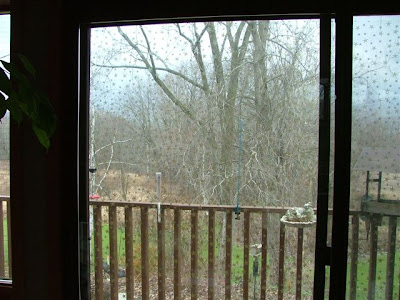
Attached is a photo of something I've been using on my windows which is very effective. My house has windows totally covering front & back. Most of the windows I netted (as I have wooden frames) but that was impossible on sliding doors & the very high upper windows.
This is the clear (with patterns) wrapping that stores use for gift packages. It sticks by static (on the inside) & can be removed easily by just pulling it off. I found that the light coloured patterns work best. It makes a visible barrier & doesn not block your view out the window altho not as beautiful (or deadly) as clean sparkling windows. It comes in big rolls, around 40" wide & a roll will do lots of windows. My house has 36 major windows + 2 sliding doors & I had plenty in one roll. It needs replacing every couple of years as it starts to lose its grip.
It really does work. I rarely have bird strikes & when I do it's only a glancing blow. Currently I have 80+ redpolls, 100+ juncos & numerous other species at my feeders.
Finally, to report some negative results, about four weeks ago I tried drawing vertical lines on the outside of the glass with a black permanent marker, but that had no effect - still lots of collisions. It might work in some situations, but not here.
Saturday, January 5, 2008
A Character Index for Redpoll identification
[edited 12 and 14 Jan, 2008, adding comments about the index]
I've been thinking about redpolls more, and had another, more careful, look at Troy's 1985 paper, which is filled with interesting observations and some serious "food for thought".
First of all, Troy identified redpoll specimens using a character index, which is a well-established method of objectively sorting out variation when there are no obvious discontinuities. I don't know why I never thought of this before, because the character index is probably the best way to classify redpolls, and it can certainly be used in the field.
I've done a series of sketches (below) showing the range of coloration of undertail coverts, flanks, and rump. I have tried to match Troy's published reference photos. You need to see each feature well enough to match it to a number, then you can add up a total score - a sort of "paleness index". Troy simply divided the range of scores into thirds: the darkest third he called Common, the palest third Hoary, and the middle third he left unidentified. This is arbitrary, but at least it's somewhat objective. Numerically, a male (pink breast) with a score from 14 to 18 was called a Hoary in Troy's paper, a score from 3 to 7 would be Common, and from 8 to 13 intermediate. For females and immatures (no pink) it only took a score of 11 or higher to qualify as a Hoary, since no female-type scored higher than 13, and a score of 3 to 6 indicated a Common; leaving 7 to 10 intermediate (I'm using the straight numbers, Troy adjusted so that the lowest score was 1).
Important: Since I have sketched my own character index, even though it is based on photos in Troy, it will give different results, and the biases of different observers will inevitably skew the results, so we can't expect Troy's numbers to work universally with my index. Also, remember that redpolls become significantly darker as their feathers wear, and Troy's study was done in summer when birds would be at their darkest. In mid-winter we should expect all the redpolls to be a little paler, and it might be necessary to adjust the index a bit.
[12 Jan - Ron Pittaway on ID-Frontiers has emphasized the seasonal changes in redpoll plumage and questioned the value of this index, but I think the darker appearance of redpolls in worn summer plumage would come almost entirely from the upperparts. The streaking features being scored by this index should not change very much. That would be easy to test with specimens. In the meantime I think the index is still a very useful tool for objectively comparing redpolls, but of course we still need to work out what the index numbers mean.
14 Jan - And another caution about using the index: Declan Troy commented that he never intended the index to identify species, only to provide a measure of variation in plumage. Then by dividing the whole range into thirds he could test pale, dark, and intermediate groups for differences in size.]
I hope this index will provide a starting point for discussion, and I encourage people to try it out, comment, and suggest revisions.
 Comments:
1) The most interesting observation in the whole paper, I think, is the fact that all redpolls from study sites in the taiga (boreal forest) were dark (low-scoring) Common-types. No intermediate or Hoary-types were found at those sites. At tundra sites most redpolls were either intermediate or Hoary, with small and variable numbers of dark birds scored as Commons. Troy found no location with exclusively pale Hoary-type birds, although a couple of far-northern sites were close to that (and in those cases it's possible that his method of simply dividing the scores into thirds was too conservative, and maybe all those intermediate birds are good Hoaries). Places like Churchill, Manitoba, with a mixture of forest and tundra habitats, show the entire range of plumage, while places farther away from the forest had a higher proportion of Hoary-types.
So, based on this, one way to look at the redpoll situation would be to name a consistently dark, southern, forest population (Common) and a paler, northern, tundra population (Hoary). In this arrangement, any redpoll paler than a typical Common could be assumed to have a tundra origin and one could make an argument for calling them all Hoary. This may seem like an extreme suggestion, but it is less extreme, and more defensible, than the current status quo, in which the Hoary name is reserved for only the very whitest individuals, and ambiguous pale birds are casually and confidently (and falsely) called "pale Commons".
One of the contradictions I have been trying to resolve in this discussion is my observation that a lot of the Hoary-type redpolls I have seen at places like Barrow and Gambell, Alaska, would not be pale enough to satisfy most observers as Hoary in the lower 48. There do seem to be true intermediate redpolls, so I don't really advocate calling all the pale birds Hoary, but calling them "pale Commons" is even worse, and simply reflects a narrow southern bias.
2) Note: There is the possibility of subtle regional variations within North America, but this has not been studied. Complex regional variations from Iceland across northern Europe makes the situation much more complicated there.
3) The three characters used by Troy - streaking on undertail coverts, rump, and flanks - are all related, so combining all three is probably not much more powerful than using a single one. Adding independent features to the identification process - especially back color and pattern - might significantly increase the separation of two species. I haven't put up an index for back color yet because it is more subjective than the three streaking features, but I'll work on that and other potential features to add. Anyone using the index should also look at back color, back pattern, fluffiness of forehead, paleness of neck sides, and perhaps other things to supplement the streakiness score.
4) Like other studies, Troy found no real difference in bill length. Actually, he did find a significant but very small difference in female bill length (premaxilla length), the difference between males of the pale and dark types was not significant. So there is a slight tendency for pale Hoary-types to have shorter bills, but it should not be emphasized as a field mark (compare the short-billed and long-billed Hoary-types in my previous post). I would compare it to the difference in bill size between Thayer's and Iceland Gulls: we get the impression that there is a difference between the two populations as a whole, but it is so small and there is so much overlap that it has very little value for identifying an individual bird. The fluffiness of feathering around the base of the bill is probably a better feature to focus on, but that is also variable, and can be tricky to assess depending on angle of view and the bird's attitude.
5) Also very interesting... At his only study site east of Hudson Bay - Fort Chimo on the northern coast of Quebec - Troy found consistently dark Common-types, averaging just slightly paler than the birds of interior Alaska but none as pale as Hoary-type. Since this is about as far north as one can get in Quebec, this suggests that pale Hoary-types may be scarce or absent east of Hudson Bay, and that the pale redpolls appearing in the east may come from farther to the northwest. Just north of Quebec, on Baffin Island, the larger Hornemann's (Greenland) Hoary Redpoll nests. So I wonder what the status of Hoary Redpoll is in mainland Canada east of Hudson Bay?
References:
Troy, D. M. 1985. A Phenetic Analysis of the Redpolls Carduelis flammea flammea and C. hornemanni exilipes. Auk 102:82-96. pdf here
I've been thinking about redpolls more, and had another, more careful, look at Troy's 1985 paper, which is filled with interesting observations and some serious "food for thought".
First of all, Troy identified redpoll specimens using a character index, which is a well-established method of objectively sorting out variation when there are no obvious discontinuities. I don't know why I never thought of this before, because the character index is probably the best way to classify redpolls, and it can certainly be used in the field.
I've done a series of sketches (below) showing the range of coloration of undertail coverts, flanks, and rump. I have tried to match Troy's published reference photos. You need to see each feature well enough to match it to a number, then you can add up a total score - a sort of "paleness index". Troy simply divided the range of scores into thirds: the darkest third he called Common, the palest third Hoary, and the middle third he left unidentified. This is arbitrary, but at least it's somewhat objective. Numerically, a male (pink breast) with a score from 14 to 18 was called a Hoary in Troy's paper, a score from 3 to 7 would be Common, and from 8 to 13 intermediate. For females and immatures (no pink) it only took a score of 11 or higher to qualify as a Hoary, since no female-type scored higher than 13, and a score of 3 to 6 indicated a Common; leaving 7 to 10 intermediate (I'm using the straight numbers, Troy adjusted so that the lowest score was 1).
Important: Since I have sketched my own character index, even though it is based on photos in Troy, it will give different results, and the biases of different observers will inevitably skew the results, so we can't expect Troy's numbers to work universally with my index. Also, remember that redpolls become significantly darker as their feathers wear, and Troy's study was done in summer when birds would be at their darkest. In mid-winter we should expect all the redpolls to be a little paler, and it might be necessary to adjust the index a bit.
[12 Jan - Ron Pittaway on ID-Frontiers has emphasized the seasonal changes in redpoll plumage and questioned the value of this index, but I think the darker appearance of redpolls in worn summer plumage would come almost entirely from the upperparts. The streaking features being scored by this index should not change very much. That would be easy to test with specimens. In the meantime I think the index is still a very useful tool for objectively comparing redpolls, but of course we still need to work out what the index numbers mean.
14 Jan - And another caution about using the index: Declan Troy commented that he never intended the index to identify species, only to provide a measure of variation in plumage. Then by dividing the whole range into thirds he could test pale, dark, and intermediate groups for differences in size.]
I hope this index will provide a starting point for discussion, and I encourage people to try it out, comment, and suggest revisions.
 Comments:
1) The most interesting observation in the whole paper, I think, is the fact that all redpolls from study sites in the taiga (boreal forest) were dark (low-scoring) Common-types. No intermediate or Hoary-types were found at those sites. At tundra sites most redpolls were either intermediate or Hoary, with small and variable numbers of dark birds scored as Commons. Troy found no location with exclusively pale Hoary-type birds, although a couple of far-northern sites were close to that (and in those cases it's possible that his method of simply dividing the scores into thirds was too conservative, and maybe all those intermediate birds are good Hoaries). Places like Churchill, Manitoba, with a mixture of forest and tundra habitats, show the entire range of plumage, while places farther away from the forest had a higher proportion of Hoary-types.
So, based on this, one way to look at the redpoll situation would be to name a consistently dark, southern, forest population (Common) and a paler, northern, tundra population (Hoary). In this arrangement, any redpoll paler than a typical Common could be assumed to have a tundra origin and one could make an argument for calling them all Hoary. This may seem like an extreme suggestion, but it is less extreme, and more defensible, than the current status quo, in which the Hoary name is reserved for only the very whitest individuals, and ambiguous pale birds are casually and confidently (and falsely) called "pale Commons".
One of the contradictions I have been trying to resolve in this discussion is my observation that a lot of the Hoary-type redpolls I have seen at places like Barrow and Gambell, Alaska, would not be pale enough to satisfy most observers as Hoary in the lower 48. There do seem to be true intermediate redpolls, so I don't really advocate calling all the pale birds Hoary, but calling them "pale Commons" is even worse, and simply reflects a narrow southern bias.
2) Note: There is the possibility of subtle regional variations within North America, but this has not been studied. Complex regional variations from Iceland across northern Europe makes the situation much more complicated there.
3) The three characters used by Troy - streaking on undertail coverts, rump, and flanks - are all related, so combining all three is probably not much more powerful than using a single one. Adding independent features to the identification process - especially back color and pattern - might significantly increase the separation of two species. I haven't put up an index for back color yet because it is more subjective than the three streaking features, but I'll work on that and other potential features to add. Anyone using the index should also look at back color, back pattern, fluffiness of forehead, paleness of neck sides, and perhaps other things to supplement the streakiness score.
4) Like other studies, Troy found no real difference in bill length. Actually, he did find a significant but very small difference in female bill length (premaxilla length), the difference between males of the pale and dark types was not significant. So there is a slight tendency for pale Hoary-types to have shorter bills, but it should not be emphasized as a field mark (compare the short-billed and long-billed Hoary-types in my previous post). I would compare it to the difference in bill size between Thayer's and Iceland Gulls: we get the impression that there is a difference between the two populations as a whole, but it is so small and there is so much overlap that it has very little value for identifying an individual bird. The fluffiness of feathering around the base of the bill is probably a better feature to focus on, but that is also variable, and can be tricky to assess depending on angle of view and the bird's attitude.
5) Also very interesting... At his only study site east of Hudson Bay - Fort Chimo on the northern coast of Quebec - Troy found consistently dark Common-types, averaging just slightly paler than the birds of interior Alaska but none as pale as Hoary-type. Since this is about as far north as one can get in Quebec, this suggests that pale Hoary-types may be scarce or absent east of Hudson Bay, and that the pale redpolls appearing in the east may come from farther to the northwest. Just north of Quebec, on Baffin Island, the larger Hornemann's (Greenland) Hoary Redpoll nests. So I wonder what the status of Hoary Redpoll is in mainland Canada east of Hudson Bay?
References:
Troy, D. M. 1985. A Phenetic Analysis of the Redpolls Carduelis flammea flammea and C. hornemanni exilipes. Auk 102:82-96. pdf here
Thursday, January 3, 2008
Parula Hybrids?
I have had two inquiries about Tropical Parula in the last 24 hours, prompted by a bird currently in Austin, Texas. You can check out that bird in photos by Andy Balinsky and photos and some background by Martin Reid. It has the throat pattern and extensively yellow underparts of Tropical Parula, but the pale eye-crescents and the extensively green crown of Northern.
In The Sibley Guide to Birds I illustrated a drab Tropical Parula with faint pale eye crescents, which is now the focus of questions. That illustration is based entirely on one specimen which was collected in southern Texas (and is currently at the Academy of Natural Sciences in Philadelphia). I strongly suspected that it was a hybrid, and discussed it with Jon Dunn, who also looked at the specimen and included a special mention of it in his and Kimball Garrett's Peterson Guide to Warblers. We both concluded that it could be a hybrid but could also be just a pale and drab variant of Tropical, since the only thing that looked odd for Tropical was the drabness and the eye crescents.
So when it came time to paint those illustrations and reduce the text to fit, I simply called it a variant of Tropical, didn't mention the hybrid possibility, and left out all the background info.
Since 2000 the evidence has piled up suggesting that Northern and Tropical Parulas do hybridize (see especially Tony Gallucci's blog post from 2005). Martin Reid also has photos of a male Tropical-like Parula with faint white eye crescents from southern Texas in 2005. I have not seen any similar specimens or photos from outside of the geographically limited area in southern Texas where the two species meet, but Tony Gallucci's map suggests tantalizingly that he has found intergrades far to the north and east of Texas. I hope we will learn more details of that soon.
From Louisiana this week, Erik Johnson has posted photos of a pure-looking Tropical Parula, but he includes the comment "many, if not most, Tropical Parula sightings outside the normal range (i.e. in Louisiana) have some evidence of Northern Parula genes or characteristics."
So I would now say that the bird I illustrated in the Guide is a hybrid, and that the Austin bird (which matches my illustration closely) is also most likely a hybrid.
And of course this just brings up more questions:
How widespread is the introgression? or How many US Tropical Parulas are pure?
Is the northeast Mexican population of Tropical Parula just part of a cline between Northerns and true Tropicals to the south? (Tony Gallucci has some interesting comments on this)
Should they be considered all one species?
Fascinating.
In The Sibley Guide to Birds I illustrated a drab Tropical Parula with faint pale eye crescents, which is now the focus of questions. That illustration is based entirely on one specimen which was collected in southern Texas (and is currently at the Academy of Natural Sciences in Philadelphia). I strongly suspected that it was a hybrid, and discussed it with Jon Dunn, who also looked at the specimen and included a special mention of it in his and Kimball Garrett's Peterson Guide to Warblers. We both concluded that it could be a hybrid but could also be just a pale and drab variant of Tropical, since the only thing that looked odd for Tropical was the drabness and the eye crescents.
So when it came time to paint those illustrations and reduce the text to fit, I simply called it a variant of Tropical, didn't mention the hybrid possibility, and left out all the background info.
Since 2000 the evidence has piled up suggesting that Northern and Tropical Parulas do hybridize (see especially Tony Gallucci's blog post from 2005). Martin Reid also has photos of a male Tropical-like Parula with faint white eye crescents from southern Texas in 2005. I have not seen any similar specimens or photos from outside of the geographically limited area in southern Texas where the two species meet, but Tony Gallucci's map suggests tantalizingly that he has found intergrades far to the north and east of Texas. I hope we will learn more details of that soon.
From Louisiana this week, Erik Johnson has posted photos of a pure-looking Tropical Parula, but he includes the comment "many, if not most, Tropical Parula sightings outside the normal range (i.e. in Louisiana) have some evidence of Northern Parula genes or characteristics."
So I would now say that the bird I illustrated in the Guide is a hybrid, and that the Austin bird (which matches my illustration closely) is also most likely a hybrid.
And of course this just brings up more questions:
How widespread is the introgression? or How many US Tropical Parulas are pure?
Is the northeast Mexican population of Tropical Parula just part of a cline between Northerns and true Tropicals to the south? (Tony Gallucci has some interesting comments on this)
Should they be considered all one species?
Fascinating.
Wednesday, January 2, 2008
A couple of Redpoll additions
On the MOU website: a Hoary photo Here from Minnesota (where Hoary is expected and the threshold is low) of a pale Hoary-type with a relatively long bill
Some other recent Hoary photos from Michigan - scroll left and right to see about 5 shots
From Ontario this photo and the two following show a very small-billed Hoary
Some other recent Hoary photos from Michigan - scroll left and right to see about 5 shots
From Ontario this photo and the two following show a very small-billed Hoary
The Redpoll Questions
More thoughts on redpolls after yesterday's post, prompted by my own nagging doubts and a query from Nick Anich: In all of this redpoll ID discussion, I think people ask the general question "How can I identify a Hoary?" when what they mean is the more specific question "Just how pale/small-billed/unstreaked does a redpoll have to be before I can feel good about calling it a Hoary?"
I don't have the answer.
We know that there is a continuum of variation from the palest Hoary to the darkest Common, and that in the middle there are some (many?) intermediate (possibly hybrid) individuals that simply cannot be confidently assigned to either species. The questions are: Where is the middle, and how far from the middle does a bird have to be before it is outside of the range of intermediacy and therefore safely identifiable?
This mirrors the challenge of other similar species-pairs like Thayer's/Iceland Gulls or Western/Glaucous-winged Gulls. One can take a very conservative approach and identify only the extreme ends of the variation, or set the threshold at any point towards the middle.
The key phrase in the original question above, then, is what it will take before I can feel good about calling a Hoary Redpoll. Such subjective decisions require experience and careful consideration, and this is also to some extent a personal decision. Some people can tolerate a "probable" or "very likely" Hoary-type, others demand more certainty. It will also depend a lot on the context of the observation. In Barrow, Alaska, where Common Redpoll is a rarity, a lot of fairly dark birds are confidently labeled "Hoary". If those same birds were seen in the lower 48, where Hoary is a rarity, I'm guessing that they would be called Common. Observers in places where Hoary Redpoll is rarer will naturally set the bar higher for identification.
The birds in my photos are subtle, and I realize that if I had seen those birds in, say, California or North Carolina, I would be reluctant to accept them as Hoaries and would want a more thorough study of all features. In other words, I am not 100% confident that they are true Hoaries. But at that feeder, where I had seen one very pale and obvious Hoary, these few birds that were on the pale side and also somewhat fluffy and small-billed seemed like good candidates for Hoary and I was comfortable sticking that label on them. They are consistent with Hoary Redpoll, and match birds I have seen in northern Alaska. Whether they are pure Hoaries, or hybrids, or maybe even pale Commons, is an open question. I've revised yesterday's post to label them "Hoary-type" redpolls, which more accurately reflects how I think of them.
Having said all that, as I browse the photos of recent claimed Hoary Redpolls in the lower 48, they all look to me like solid Hoaries.
James Smith's photos from Gloucester, MA
James Smith's Redpoll pages from NH, winter 2003-04
Some recent photos from Michigan
I think people are being admirably conservative, and that such pale birds are well towards the pale side of redpoll variation and are safely identified as Hoary. It's understandable to wish for more certainty, but, if you can tolerate the uncertainty, I think there's a lot to be learned by looking for and studying the more subtle and intermediate birds.
Another excellent resource for redpoll info from Ron Pittaway is here
I don't have the answer.
We know that there is a continuum of variation from the palest Hoary to the darkest Common, and that in the middle there are some (many?) intermediate (possibly hybrid) individuals that simply cannot be confidently assigned to either species. The questions are: Where is the middle, and how far from the middle does a bird have to be before it is outside of the range of intermediacy and therefore safely identifiable?
This mirrors the challenge of other similar species-pairs like Thayer's/Iceland Gulls or Western/Glaucous-winged Gulls. One can take a very conservative approach and identify only the extreme ends of the variation, or set the threshold at any point towards the middle.
The key phrase in the original question above, then, is what it will take before I can feel good about calling a Hoary Redpoll. Such subjective decisions require experience and careful consideration, and this is also to some extent a personal decision. Some people can tolerate a "probable" or "very likely" Hoary-type, others demand more certainty. It will also depend a lot on the context of the observation. In Barrow, Alaska, where Common Redpoll is a rarity, a lot of fairly dark birds are confidently labeled "Hoary". If those same birds were seen in the lower 48, where Hoary is a rarity, I'm guessing that they would be called Common. Observers in places where Hoary Redpoll is rarer will naturally set the bar higher for identification.
The birds in my photos are subtle, and I realize that if I had seen those birds in, say, California or North Carolina, I would be reluctant to accept them as Hoaries and would want a more thorough study of all features. In other words, I am not 100% confident that they are true Hoaries. But at that feeder, where I had seen one very pale and obvious Hoary, these few birds that were on the pale side and also somewhat fluffy and small-billed seemed like good candidates for Hoary and I was comfortable sticking that label on them. They are consistent with Hoary Redpoll, and match birds I have seen in northern Alaska. Whether they are pure Hoaries, or hybrids, or maybe even pale Commons, is an open question. I've revised yesterday's post to label them "Hoary-type" redpolls, which more accurately reflects how I think of them.
Having said all that, as I browse the photos of recent claimed Hoary Redpolls in the lower 48, they all look to me like solid Hoaries.
James Smith's photos from Gloucester, MA
James Smith's Redpoll pages from NH, winter 2003-04
Some recent photos from Michigan
I think people are being admirably conservative, and that such pale birds are well towards the pale side of redpoll variation and are safely identified as Hoary. It's understandable to wish for more certainty, but, if you can tolerate the uncertainty, I think there's a lot to be learned by looking for and studying the more subtle and intermediate birds.
Another excellent resource for redpoll info from Ron Pittaway is here
Tuesday, January 1, 2008
My Holiday (Redpoll) Photos
[Edited 2 Jan to add a hint of uncertainty to the identifications]
Over the holidays I was able to spend a few days at my parents' house in upstate New York, and enjoyed the redpolls that were visiting the bird feeder. I saw one clear-cut Hoary and at least two other Hoary-type Redpolls, and at least one "Greater" Common Redpoll among the flocks of regular Commons. There were up to about 60 redpolls at once visiting the feeder, but there must have been far more that passed through during the biggest day (29 Dec) since the unusual redpolls were each only seen for brief periods. I set up my Wingscapes Birdcam and just let it run, and ended up with a pretty good assortment of redpoll pictures, including a couple of Hoaries that I didn't see in real life.
I saw one really pale Hoary that stood out as a very white bird. Unfortunately that one didn't get caught by the birdcam. I did get pictures of several of the more subtle Hoary-types (clicking an any picture below will bring up a higher resolution image that shows more detail).
Here's a typical scene under the feeder:

Notice the brownish backs of the Commons, and the one paler bird towards the right is an adult male (pink showing on the breast) so it's just a Common. Below is a shot from a few minutes later, and there on the left is a paler bird - a female Hoary-type!

Notice the grayish back without the brown scapulars of the Commons, the clean white facial markings and pale neck. But it's certainly not "obvious". Below is the same bird moments later next to a Common:

Again, compare the ground color of the sides of the back (and scapulars). Commons typically have two white stripes down the center of the back, contrasting with brown stripes towards the sides. On Hoary the back is more uniform - white in the center and pale gray on the sides. Towards the rear, where the rear scapulars overlap the wing coverts and tertials, Hoaries have the scapulars edged whitish so the rear edges of the back are paler, where the same feathers on Common are just brown. The pale edges of wing and tail feathers are whiter and broader, the supercilium is unstreaked white, and the sides of the neck are pale and faintly streaked.
Below is another Hoary-type (more subtle) with its back to the camera:

And a Common in similar pose below:
 Notice the difference in back color and pattern. The pattern and extent of wing markings is similar (and extremely variable) in both species, but Hoaries often look whiter there. And below is the same Hoary-type with its head up:
 Notice the short, stubby bill, pale neck sides, "frosty" back and wings. Below is a rather large-billed Common to compare, but bill size is not always different:
 Finally, below is an ambiguous individual:
 This bird is heavily-streaked below and on the neck-sides, a bit brownish on the back, etc, and I doubt that anyone would call it anything other than a Common, but it's paler and grayer above than a typical Common, and could be intermediate. [One might say this is on the Common side of intermediate, while the Hoary-type above is on the Hoary side of intermediate. Both may be unidentifiable, or at least many people would want to see a less ambiguous individual before making the call.]
After this experience I suggest that back color is one of the best things to look for as a first-cut. Then try neck-side markings, bill size, streaking on flanks and undertail coverts, and then other features. The paler color of Hoary is expressed as an overall whiteness and "clean" or "frosty" appearance. For example, on birds with a buffy wash on the face and throat this leads to a cleaner yellow-buff color, which on Commons is sullied by thin streaks and dusky smudges. All features overlap between the two species, and it's difficult to find anything objective to latch onto and to support an identification. Therefore it will be difficult to identify the more subtle Hoary Redpolls unless you get a really good look at the whole bird and have looked carefully at many other redpolls, but there is definitely a clean, pale overall appearance that is associated with Hoary.
Over the holidays I was able to spend a few days at my parents' house in upstate New York, and enjoyed the redpolls that were visiting the bird feeder. I saw one clear-cut Hoary and at least two other Hoary-type Redpolls, and at least one "Greater" Common Redpoll among the flocks of regular Commons. There were up to about 60 redpolls at once visiting the feeder, but there must have been far more that passed through during the biggest day (29 Dec) since the unusual redpolls were each only seen for brief periods. I set up my Wingscapes Birdcam and just let it run, and ended up with a pretty good assortment of redpoll pictures, including a couple of Hoaries that I didn't see in real life.
I saw one really pale Hoary that stood out as a very white bird. Unfortunately that one didn't get caught by the birdcam. I did get pictures of several of the more subtle Hoary-types (clicking an any picture below will bring up a higher resolution image that shows more detail).
Here's a typical scene under the feeder:

Notice the brownish backs of the Commons, and the one paler bird towards the right is an adult male (pink showing on the breast) so it's just a Common. Below is a shot from a few minutes later, and there on the left is a paler bird - a female Hoary-type!

Notice the grayish back without the brown scapulars of the Commons, the clean white facial markings and pale neck. But it's certainly not "obvious". Below is the same bird moments later next to a Common:

Again, compare the ground color of the sides of the back (and scapulars). Commons typically have two white stripes down the center of the back, contrasting with brown stripes towards the sides. On Hoary the back is more uniform - white in the center and pale gray on the sides. Towards the rear, where the rear scapulars overlap the wing coverts and tertials, Hoaries have the scapulars edged whitish so the rear edges of the back are paler, where the same feathers on Common are just brown. The pale edges of wing and tail feathers are whiter and broader, the supercilium is unstreaked white, and the sides of the neck are pale and faintly streaked.
Below is another Hoary-type (more subtle) with its back to the camera:

And a Common in similar pose below:
 Notice the difference in back color and pattern. The pattern and extent of wing markings is similar (and extremely variable) in both species, but Hoaries often look whiter there. And below is the same Hoary-type with its head up:
 Notice the short, stubby bill, pale neck sides, "frosty" back and wings. Below is a rather large-billed Common to compare, but bill size is not always different:
 Finally, below is an ambiguous individual:
 This bird is heavily-streaked below and on the neck-sides, a bit brownish on the back, etc, and I doubt that anyone would call it anything other than a Common, but it's paler and grayer above than a typical Common, and could be intermediate. [One might say this is on the Common side of intermediate, while the Hoary-type above is on the Hoary side of intermediate. Both may be unidentifiable, or at least many people would want to see a less ambiguous individual before making the call.]
After this experience I suggest that back color is one of the best things to look for as a first-cut. Then try neck-side markings, bill size, streaking on flanks and undertail coverts, and then other features. The paler color of Hoary is expressed as an overall whiteness and "clean" or "frosty" appearance. For example, on birds with a buffy wash on the face and throat this leads to a cleaner yellow-buff color, which on Commons is sullied by thin streaks and dusky smudges. All features overlap between the two species, and it's difficult to find anything objective to latch onto and to support an identification. Therefore it will be difficult to identify the more subtle Hoary Redpolls unless you get a really good look at the whole bird and have looked carefully at many other redpolls, but there is definitely a clean, pale overall appearance that is associated with Hoary.
More on Redpolls
After my previous posts on redpolls here and here, I've had a chance to skim some of the redpoll literature, and it confirms that these are two very similar species (gasp! really?). Two papers in particular by Seutin et al (1992, 1993) offer some interesting observations. They conclude that it is possible to classify specimens into either a small-billed pale population or a large-billed dark population (about 87% of the time), and that Hoary and Common "may be specifically distinct".
One important point is that redpolls molt only once each year - in late summer. So the pale tips and edges of new feathers will gradually wear off during the year, leading to a slight but significant darkening of the plumage month to month throughout the year. This is not a big issue for birders in the field, since we will generally be comparing redpolls to their companions in real time, but museum workers have to be careful to compare only specimens from similar dates. It is suggested that Troy (1985) - who concluded that there are not two distinct populations - did not adequately control for date and for age and sex.
What Seutin et al found is that specimens can be sorted by measurements, with pale (Hoary-types) having shorter bills by about 10% on average; means of 7.67 mm for dark birds and 7.01 for pale. Taking their mean for bill length +/- 2 standard deviations (I'm told this will encompass about 95% of all individuals) the bill measurements don't look so different:
Common 7 - 8.2 mm
Hoary 6.5 - 7.5 mm
In other words, the differences are very slight, and there is extensive overlap, with the largest Hoary matching the average Common and the smallest Common matching the average Hoary.
Importantly, measurements of bill depth do not differ significantly between the species, so a Hoary should have a short and stout bill (if a 7 mm bill can be called stout). In other words, a Common's bill should be longer and more slender, a Hoary's shorter and stubbier. But this is also subject to overlap, and we don't know if the longest-billed Hoaries still have a relatively thick bill or a bill shape just like Common (or if the shortest-billed Commons have slender or stout bills).
Measurements of tarsus and hallux (hind claw) were also significantly smaller on pale birds, but it is not likely that either of these measurements will be helpful to birders. Wing and tail averaged very slightly larger on Hoary-types, but not significantly so.
In their study of plumage, Seutin et al. found that most adult males could be distinguished by darkness and thickness of streaking on flanks, undertail coverts, and rump, but that females and immatures were much less distinct. They also studied forehead color and "poll" color (the red crown patch) and found no significant difference. Unfortunately they did not measure scapular color, wing markings, neck markings, or other plumage features that now seem like they might be useful.
Breast color also distinguished nearly all adult males in summer, with Commons having deeper red color and Hoaries a pale pink. This color is obscured by pale feather tips in fresh plumage in fall, which gradually wear off to reveal the reddish color by summer. Some of the underlying color is usually visible from at least December on, under the fringing whitish feather tips, and may be a helpful clue on adult males. But this should only be used on adult males with unstreaked and extensively colored breasts (see Brooks, 1973) and these birds are generally the most easily identified by overall darkness.
 Typical breast color of adult male Common Redpoll (left) and adult male Hoary Redpoll (right)
References:
Brooks, W. S. 1973. A tentative key for sex determination of Common Redpolls (Acanthis flammea flammea) in the northern United States during winter. Journal of Field Ornithology 44:13-21. pdf here
Seutin, G., et al. 1992. Plumage variability in Redpolls from Churchill, Manitoba. Auk 109:771-785. pdf here
Seutin, G., et al. 1993. Morphometric Variability in Redpolls from Churchill, Manitoba. Auk 11o:832-843. pdf here
Troy, D. M. 1985. A Phenetic Analysis of the Redpolls Carduelis flammea flammea and C. hornemanni exilipes. Auk 102:82-96. pdf here
One important point is that redpolls molt only once each year - in late summer. So the pale tips and edges of new feathers will gradually wear off during the year, leading to a slight but significant darkening of the plumage month to month throughout the year. This is not a big issue for birders in the field, since we will generally be comparing redpolls to their companions in real time, but museum workers have to be careful to compare only specimens from similar dates. It is suggested that Troy (1985) - who concluded that there are not two distinct populations - did not adequately control for date and for age and sex.
What Seutin et al found is that specimens can be sorted by measurements, with pale (Hoary-types) having shorter bills by about 10% on average; means of 7.67 mm for dark birds and 7.01 for pale. Taking their mean for bill length +/- 2 standard deviations (I'm told this will encompass about 95% of all individuals) the bill measurements don't look so different:
Common 7 - 8.2 mm
Hoary 6.5 - 7.5 mm
In other words, the differences are very slight, and there is extensive overlap, with the largest Hoary matching the average Common and the smallest Common matching the average Hoary.
Importantly, measurements of bill depth do not differ significantly between the species, so a Hoary should have a short and stout bill (if a 7 mm bill can be called stout). In other words, a Common's bill should be longer and more slender, a Hoary's shorter and stubbier. But this is also subject to overlap, and we don't know if the longest-billed Hoaries still have a relatively thick bill or a bill shape just like Common (or if the shortest-billed Commons have slender or stout bills).
Measurements of tarsus and hallux (hind claw) were also significantly smaller on pale birds, but it is not likely that either of these measurements will be helpful to birders. Wing and tail averaged very slightly larger on Hoary-types, but not significantly so.
In their study of plumage, Seutin et al. found that most adult males could be distinguished by darkness and thickness of streaking on flanks, undertail coverts, and rump, but that females and immatures were much less distinct. They also studied forehead color and "poll" color (the red crown patch) and found no significant difference. Unfortunately they did not measure scapular color, wing markings, neck markings, or other plumage features that now seem like they might be useful.
Breast color also distinguished nearly all adult males in summer, with Commons having deeper red color and Hoaries a pale pink. This color is obscured by pale feather tips in fresh plumage in fall, which gradually wear off to reveal the reddish color by summer. Some of the underlying color is usually visible from at least December on, under the fringing whitish feather tips, and may be a helpful clue on adult males. But this should only be used on adult males with unstreaked and extensively colored breasts (see Brooks, 1973) and these birds are generally the most easily identified by overall darkness.
 Typical breast color of adult male Common Redpoll (left) and adult male Hoary Redpoll (right)
References:
Brooks, W. S. 1973. A tentative key for sex determination of Common Redpolls (Acanthis flammea flammea) in the northern United States during winter. Journal of Field Ornithology 44:13-21. pdf here
Seutin, G., et al. 1992. Plumage variability in Redpolls from Churchill, Manitoba. Auk 109:771-785. pdf here
Seutin, G., et al. 1993. Morphometric Variability in Redpolls from Churchill, Manitoba. Auk 11o:832-843. pdf here
Troy, D. M. 1985. A Phenetic Analysis of the Redpolls Carduelis flammea flammea and C. hornemanni exilipes. Auk 102:82-96. pdf here
Monday, December 31, 2007
What are the odds?

Part 1:
On 6 December 2007 at about 8PM, in the midst of an intense winter storm, a resident of Lilllooet, BC heard a thump on their front door. Thinking the dog wanted to come in, they opened the door to find a strange bird lying on the front porch. It later died despite their best efforts, and it turns out to be a Cook's Petrel (although similar species still need to be ruled out)! This is the first for BC and for Canada.
Lillooet is west of Kamloops, in southern interior BC. It is over 100 miles to the nearest salt water, and at least 250 miles to the nearest open ocean where a Cook's Petrel would be "comfortable". How many were blown into BC and simply perished in bogs and lakes? Maybe only one, but what are the odds that the only one happened to crash into the front door of a house? And on top of that a house where the residents would take enough interest to report it?
---------------------------------------------
Part 2:
In early December 2007 it was reported on the OregonBirds listserv that a Jacksnipe had been shot by a hunter in November - a first record for Oregon and only the 6th for North America of this secretive and cryptic species. But then it was discovered that the same hunter shot a Jacksnipe in the same area of coastal Oregon in late October 2004 , making this the 7th for North America.
How many other Jacksnipes have been shot and never reported? How many are wintering along the Pacific coast of North America? Maybe none. But what are the odds that one snipe-hunter, in a single patch of coastal Oregon, could personally find about one-third of all the North American records of this species?
----------------------------------------------
Part 3:
On 23 December 2007 I went on one of my infrequent birding trips to Cape Ann, Massachusetts with my son and two friends. I was aware of recent Slaty-backed Gulls in Illinois and Pennsylvania, so my expectations were up, but it was still a shock to see a Slaty-backed Gull in Gloucester Harbor - the first ever for Massachusetts. I even thought that "the" bird an hour later had a very different looking bill color, and the next day Rick Heil was able to confirm that there were indeed two Slaty-backed Gulls in Gloucester. Most amazing, just an hour or so after I saw the first one in Gloucester, Wayne Petersen and Dave Larsen found another individual on Cape Cod (they thought they had a first state record, only to find that theirs was the second ... or third, by a matter of minutes - Ouch!).
How many other Slaty-backed Gulls are scattered around the eastern US? Maybe only these few. But what are the odds that the very-thoroughly-birded state of Massachusetts would suddenly have three records? Interestingly, at Gloucester and Cape Cod, the Slaty-backeds coincided with an unprecedented invasion of hundreds of Bohemian Waxwings. It seems bizarre to even suggest that movements of these species are related, but could it be just a coincidence?
---------------------------------------
And now we enter a new year filled with possibilities....
Thursday, December 6, 2007
Calendars and columns
I was in Washington DC recently and signed some calendars at my cousin's flower shop in Mount Airy, Maryland. So if you've been thinking about getting a calendar and you'd like one that I've signed, you can order them here.
And my new Birder's World column about identifying songbirds by flocking habits is now available online here.
And my new Birder's World column about identifying songbirds by flocking habits is now available online here.
Perspective on a mystery bird
Our perspective and the assumptions and decisions that are triggered by that point-of-view, strongly influence how we perceive the world around us. In short, what we see often depends on how we look at it.
This classic drawing looks like a frog sitting on the edge of a pond...
 but rotate it ninety degrees and it turns into a horse's head!
 This horse/frog drawing comes from a generic internet source and I assume it is public domain.
If not please let me know, and if anyone knows the artist or original source I'd like to give credit.
We can all remember times when we've experienced this kind of perceptual flip-flop in real life, insisting one thing is correct only to realize in a flash that our underlying assumptions - and our conclusions - were wrong. It certainly comes up a lot in bird identification. A flash of what "could only be" a male Yellow-headed Blackbird resolves into a Common Grackle holding a corn chip; or a carefully-studied Western Sandpiper turns into a Dunlin when it walks next to a much smaller Least.
Clear photographic examples of this are rare, but one such example is this mysterious photo of an apparently black-faced bird taken in late September 2007 by an automatic Wingscapes birdcam and discussed on the Birdcouple blog, with most viewers suggesting either a Carolina Chickadee or a Common Redstart (a Eurasian species not previously recorded in North America).
 Photo by Warren and Lisa Strobel. Used by permission.
We probably all look at this picture and assume, quite reasonably, that the bird is holding it's head in a normal position looking to the left and slightly down. And in the image below I've zoomed in and taken the liberty of adding the outline of an eye in about the right position to fit this assumption. In this case the pattern of black face, pale crown, pinkish-buff underside, etc. is a pretty good match for Common Redstart. There are lots of details that are not quite right, some of which have been mentioned in comments with the original blog post. Many experienced birders will notice the details, or simply note that the location is very unlikely for Common Redstart, and will step back to look for another explanation. (If you think the eye looks like it isn't in quite the right place, I can assure you that I moved it around in photoshop and this was the best placement I could find. The eye just doesn't fit this way, which is another clue that the black pattern and head shape is not right for Redstart.)

Below, again, I've taken the liberty of adding a dark spot, this time to show where I think the eye actually is (and a helpful arrow to point it out). I think the head is rotated ninety degrees and the bird is looking up at the sky with one eye, so we're seeing the black throat, and the white band on the upper edge of the head is the "cheek". With the eye in this position the bird's head plumage is a perfect match for Carolina Chickadee. Other details also fit and give no reason to question the ID, and the species is common in the area where the photo was taken.
 So I agree completely with the few respondents who have already suggested that this bird is a Carolina Chickadee with its head turned. This particular identification pitfall might never come up in field observations, when we would be able to see the bird move and quickly correct our error, but lots of similar things do happen under field conditions. This story demonstrates that there are nearly infinite possibilities for misidentification, and shows how one misleading glimpse can trigger assumptions that set us firmly onto the wrong path.
This classic drawing looks like a frog sitting on the edge of a pond...
 but rotate it ninety degrees and it turns into a horse's head!
 This horse/frog drawing comes from a generic internet source and I assume it is public domain.
If not please let me know, and if anyone knows the artist or original source I'd like to give credit.
Clear photographic examples of this are rare, but one such example is this mysterious photo of an apparently black-faced bird taken in late September 2007 by an automatic Wingscapes birdcam and discussed on the Birdcouple blog, with most viewers suggesting either a Carolina Chickadee or a Common Redstart (a Eurasian species not previously recorded in North America).
 Photo by Warren and Lisa Strobel. Used by permission.
Below, again, I've taken the liberty of adding a dark spot, this time to show where I think the eye actually is (and a helpful arrow to point it out). I think the head is rotated ninety degrees and the bird is looking up at the sky with one eye, so we're seeing the black throat, and the white band on the upper edge of the head is the "cheek". With the eye in this position the bird's head plumage is a perfect match for Carolina Chickadee. Other details also fit and give no reason to question the ID, and the species is common in the area where the photo was taken.
 So I agree completely with the few respondents who have already suggested that this bird is a Carolina Chickadee with its head turned. This particular identification pitfall might never come up in field observations, when we would be able to see the bird move and quickly correct our error, but lots of similar things do happen under field conditions. This story demonstrates that there are nearly infinite possibilities for misidentification, and shows how one misleading glimpse can trigger assumptions that set us firmly onto the wrong path.
Tuesday, December 4, 2007
Redpoll subspecies
If identifying Hoary Redpoll is not enough of a challenge for you, maybe you'd like to look for subspecies of Hoary and Common Redpolls?
First, check out this map from the Canadian Atlas of Bird Banding.
 This shows selected western band recoveries of Common Redpolls, and the obvious suggestion is that some of the Common Redpolls being seen in the east right now might be coming from Alaska! Troy (1983) shows a map with a similar pattern, including a redpoll that traveled from New Hampshire to Barrow, Alaska, and another that traveled from Michigan to Siberia. Lots of redpolls also come to the eastern US from the north or northeast, but we should not assume that we are only seeing redpolls from the nearby subarctic regions.
Both species of redpoll are represented in Greenland and Baffin Island by larger and more distinctive subspecies. These "Greenland" Hoary Redpolls are large and very pale, while the "Greenland" Common Redpolls are large and dark. An excellent summary of status and identification is in Pittaway (1992). Greater Common Redpoll can appear in the eastern US in significant numbers some winters, outnumbering Hoary (Pittaway 1992, Wetherbee 1937). Hornemann's Hoary Redpoll is the rarest subspecies in the US, but has been recorded at least south to Maryland and west to Michigan.
Other references:
Pittaway, R. 1992. Recognizable Forms: Redpolls. Ontario Birds 10(3): 108-114
Troy, D. M. 1983. Recaptures of Redpolls: Movements of an Irruptive species. J. Field Ornithol., 54: 146-151.
First, check out this map from the Canadian Atlas of Bird Banding.
 This shows selected western band recoveries of Common Redpolls, and the obvious suggestion is that some of the Common Redpolls being seen in the east right now might be coming from Alaska! Troy (1983) shows a map with a similar pattern, including a redpoll that traveled from New Hampshire to Barrow, Alaska, and another that traveled from Michigan to Siberia. Lots of redpolls also come to the eastern US from the north or northeast, but we should not assume that we are only seeing redpolls from the nearby subarctic regions.
Both species of redpoll are represented in Greenland and Baffin Island by larger and more distinctive subspecies. These "Greenland" Hoary Redpolls are large and very pale, while the "Greenland" Common Redpolls are large and dark. An excellent summary of status and identification is in Pittaway (1992). Greater Common Redpoll can appear in the eastern US in significant numbers some winters, outnumbering Hoary (Pittaway 1992, Wetherbee 1937). Hornemann's Hoary Redpoll is the rarest subspecies in the US, but has been recorded at least south to Maryland and west to Michigan.
Common Redpoll Carduelis flammea
Southern C. f. flammea
Greenland (Greater) C. f. rostrata
Greater is distinguished from Southern by:
- larger size
- darker color
- larger bill with curved (bulging) culmen
- said to have more upright posture and harsher calls
Southern C. h. exilipes
Greenland (Hornemann's) C. h. hornemanni
- larger size
- even paler color
Other references:
Pittaway, R. 1992. Recognizable Forms: Redpolls. Ontario Birds 10(3): 108-114
Troy, D. M. 1983. Recaptures of Redpolls: Movements of an Irruptive species. J. Field Ornithol., 54: 146-151.
Saturday, December 1, 2007
Redpoll Identification
Some updates 4 and 6 December -
check out Jochen's comments and blog post here
With the predicted superflight of finches beginning to develop (1st ever Common Redpoll in New Mexico last week) more and more questions are coming up about finch identification.
Redpolls
Hoary Redpoll, although always less numerous than Common south of the Arctic, is probably more numerous than reports indicate. Identification is very difficult, requiring close and lengthy study, and observers are usually conservative on this ID, so lots of darker Hoarys are never even picked out, possible Hoarys are never confirmed, and lots of passing flocks are simply reported as Commons (1).
If you have a chance to study some redpolls and want to look for Hoary, here are some tips:
At this link you can see photos of a recent Hoary and accompanying Commons in Indiana by Peter Grube, showing the features well.
Good luck!
Notes:
1) A reader suggests that many people are not as conservative as perhaps they should be, and simply slap the "Hoary" label on any noticeably pale redpoll. I agree, but I also think that many true Hoarys are overlooked, so it may actually be that many birds reported as Hoarys are not, but an equal or greater number of real Hoarys are overlooked!
2) Other features that have been mentioned and that might be worth watching for and testing (but many of these are very subjective and my impression currently is that these are less useful than the ones mentioned above):
check out Jochen's comments and blog post here
With the predicted superflight of finches beginning to develop (1st ever Common Redpoll in New Mexico last week) more and more questions are coming up about finch identification.
Redpolls
Hoary Redpoll, although always less numerous than Common south of the Arctic, is probably more numerous than reports indicate. Identification is very difficult, requiring close and lengthy study, and observers are usually conservative on this ID, so lots of darker Hoarys are never even picked out, possible Hoarys are never confirmed, and lots of passing flocks are simply reported as Commons (1).
If you have a chance to study some redpolls and want to look for Hoary, here are some tips:
- The first step is simply to scan the group looking for a paler bird. But by just looking through a flock for paler color you will miss a lot of Hoary Redpolls. With practice you should begin to look for the specific types of paleness listed below - a "frosty" look to the upperparts or wings, a whiter breast, a pale rump, etc.
- Once you've found a pale redpoll, check the breast color - If it has pink on the breast it's a male (most 1st winter males have pink on the breast according to Pyle 1997), and identification of males is generally a little easier, but since males of both species tend to be paler than females, a male Common can often stand out as the palest bird in the flock. A male Hoary should look really pale. If there is no pink it's a female (or possibly an immature male), and identification will be more challenging, but since females of both species tend to be darker than the males, the fact that you've picked out a pale female from the flock is promising.
- the scapulars should be paler with frosty whitish edges on Hoary
- flank streaking should be sparse and narrow on Hoary
- undertail coverts should be white or with only narrow streaks on Hoary (female Hoary often have narrow shaft streaks not as broad as on Commons, and male Common can have no streaks)
- rump should be mostly white on Hoary, whiter on males (but male Commons can also have a noticeably pale rump)
- the bill should look short and small, with fluffy nasal bristles covering the base of the upper mandible and making the forehead bulge a bit (but Commons also have tiny bills, you have to study some Commons at close range before you will feel confident using this feature)
- The pale edges on the wing coverts and secondaries should be broader and whiter on Hoary (but this is variable in both species and, as with all of these clues, it's important to compare birds of the same sex) (2)
At this link you can see photos of a recent Hoary and accompanying Commons in Indiana by Peter Grube, showing the features well.
Good luck!
Notes:
1) A reader suggests that many people are not as conservative as perhaps they should be, and simply slap the "Hoary" label on any noticeably pale redpoll. I agree, but I also think that many true Hoarys are overlooked, so it may actually be that many birds reported as Hoarys are not, but an equal or greater number of real Hoarys are overlooked!
2) Other features that have been mentioned and that might be worth watching for and testing (but many of these are very subjective and my impression currently is that these are less useful than the ones mentioned above):
- a smaller and brighter red "poll" on the forehead of Hoary
- less dark color on the throat and lores on Hoary: more restricted and not as dark (but appearance varies with angle of view)
- Hoary overall larger and fluffier (but note subspecies differences in size)
- neck appears thicker on Hoary
- fluffy "leggings" on Hoary
- A tendency for Hoary to raise tail when foraging on the ground
- relatively longer tail
- there may be subtle differences in calls, and this deserves more testing, but singling one calling bird out of a flock is usually impossible. The larger "Greenland" subspecies also may have different calls.
Tuesday, November 20, 2007
More on windows and birds
After a week of pretty good success on the windows, today was cold with light snow, and the bird feeder was very active. I realized last week that one of many variables I need to consider when I record bird-strikes-per-hour is bird activity, but I haven't tried to record that yet other than excluding long periods when no birds were present. Obviously, if there are few birds visiting, there are fewer chances for collisions. At the other extreme, like today, when the feeder gets crowded there seem to be birds in the air all the time - hovering and jostling for a perch. In these conditions there are many more chances for collisions.
So today I started observing and recorded 6 window strikes in 1 hour 40 minutes - about one every 16 minutes. Thinking that this was happening because of the faded highlighter I reapplied the lines, and in the next 3 hours 30 minutes there were 8 strikes, or about one every 33 minutes - about half as frequent but still pretty distressing and not really a significant improvement. However (one can always find a hopeful angle) five times during that period birds flew in and landed scratching at the windowsill. Maybe these were birds that would have crashed into the glass, but recognized the danger at the last second and fluttered harmlessly down to the windowsill.
A physics lesson
Some of my assumptions about UV light and what birds perceive were wrong, and I've been educated by some posts on the NikonGear UV photography forum, and some follow-up research. What we see under the black light is fluorescence. Certain compounds are "excited" as they absorb UV energy and then - when electrons return to their normal state - they fluoresce: releasing energy as light in the visible range. So this is why day-glo colors appear intensely bright in sunlight - UV energy from the sun causes fluorescence, and the colors actually glow.
Therefore my experiment with the black light has very little to do with UV other than as the light source. The black light is good for finding fluorescent things, and fluorescence begins with UV absorption, but many things absorb or reflect UV without fluorescing and we simply can't see it. A search for UV-visible substances to mark windows would require much more specialized equipment. You can see some really cool examples of UV photography here.
The fluorescent highlighter should still be visible to birds, because the fluorescent ink will simultaneously absorb UV and release visible light. But the visible fluorescence in daylight may be about as obvious to the birds as it is to us (i.e. not very). So if the highlighter works it may work largely because it absorbs UV, or maybe the combination of absorbing UV and releasing visible light is more obvious to the birds. Either way, that process requires a UV light source, and another issue that I think might explain today's poor results (still searching for that hopeful angle) is that UV wavelengths are blocked by clouds. Apparently "thin" clouds allow about 60-80% of UVA (the longest wavelengths of UV and the range that birds can see) to pass through, but thicker clouds block most UVA. So with little or no UV, such as during today's snowstorm, the highlighter marks would neither absorb UV nor release fluorescence, and the birds' vision would rely on the same visible spectrum that we see. If this is true then all efforts to use UV-related markings on glass will only have limited effectiveness (but don't take my word for it). So I'll have to note weather conditions in the future as I record window strikes to see if the highlighter is more effective on sunny days.
By the way, window glass blocks some shorter UV wavelengths, but at least 90% of UVA apparently does pass through ordinary glass.
So what does this mean?
Well, clearly the highlighter is not the "magic bullet" that everyone is hoping for. I'm still anxious to hear from others who have tried it. So far I have two responses indicating that it works, and I'd like to hear more, but if anyone has tried it without success I'm especially interested to hear about that.
If it does work, it will presumably work best in sunlight, and worst in low light or on overcast days, and unfortunately bird feeders are generally most active at those times.
As I said previously, we can keep trying to find ways to make the reflection in the glass look unattractive to the birds, but there will always be things (like hawks) that look even less attractive and cause birds to try to escape through the window. To truly prevent window strikes will require a barrier such as the BirdScreen.
So today I started observing and recorded 6 window strikes in 1 hour 40 minutes - about one every 16 minutes. Thinking that this was happening because of the faded highlighter I reapplied the lines, and in the next 3 hours 30 minutes there were 8 strikes, or about one every 33 minutes - about half as frequent but still pretty distressing and not really a significant improvement. However (one can always find a hopeful angle) five times during that period birds flew in and landed scratching at the windowsill. Maybe these were birds that would have crashed into the glass, but recognized the danger at the last second and fluttered harmlessly down to the windowsill.
A physics lesson
Some of my assumptions about UV light and what birds perceive were wrong, and I've been educated by some posts on the NikonGear UV photography forum, and some follow-up research. What we see under the black light is fluorescence. Certain compounds are "excited" as they absorb UV energy and then - when electrons return to their normal state - they fluoresce: releasing energy as light in the visible range. So this is why day-glo colors appear intensely bright in sunlight - UV energy from the sun causes fluorescence, and the colors actually glow.
Therefore my experiment with the black light has very little to do with UV other than as the light source. The black light is good for finding fluorescent things, and fluorescence begins with UV absorption, but many things absorb or reflect UV without fluorescing and we simply can't see it. A search for UV-visible substances to mark windows would require much more specialized equipment. You can see some really cool examples of UV photography here.
The fluorescent highlighter should still be visible to birds, because the fluorescent ink will simultaneously absorb UV and release visible light. But the visible fluorescence in daylight may be about as obvious to the birds as it is to us (i.e. not very). So if the highlighter works it may work largely because it absorbs UV, or maybe the combination of absorbing UV and releasing visible light is more obvious to the birds. Either way, that process requires a UV light source, and another issue that I think might explain today's poor results (still searching for that hopeful angle) is that UV wavelengths are blocked by clouds. Apparently "thin" clouds allow about 60-80% of UVA (the longest wavelengths of UV and the range that birds can see) to pass through, but thicker clouds block most UVA. So with little or no UV, such as during today's snowstorm, the highlighter marks would neither absorb UV nor release fluorescence, and the birds' vision would rely on the same visible spectrum that we see. If this is true then all efforts to use UV-related markings on glass will only have limited effectiveness (but don't take my word for it). So I'll have to note weather conditions in the future as I record window strikes to see if the highlighter is more effective on sunny days.
By the way, window glass blocks some shorter UV wavelengths, but at least 90% of UVA apparently does pass through ordinary glass.
So what does this mean?
Well, clearly the highlighter is not the "magic bullet" that everyone is hoping for. I'm still anxious to hear from others who have tried it. So far I have two responses indicating that it works, and I'd like to hear more, but if anyone has tried it without success I'm especially interested to hear about that.
If it does work, it will presumably work best in sunlight, and worst in low light or on overcast days, and unfortunately bird feeders are generally most active at those times.
As I said previously, we can keep trying to find ways to make the reflection in the glass look unattractive to the birds, but there will always be things (like hawks) that look even less attractive and cause birds to try to escape through the window. To truly prevent window strikes will require a barrier such as the BirdScreen.
Thursday, November 15, 2007
A Potential Simple Method for "Bird-Proofing" Windows
Update 16 November - There are a couple of points I think I should clarify. First - and I guess this may be clear already - I'm still not convinced this will work, or how well it will work, and it will probably work in some situations better than others, and never be 100% effective since the hard glass surface is still exposed. If you try it please let me know how it works, good or bad.
I should have mentioned the Bird Screen, which apparently does offer nearly 100% protection, and might be the best solution for a lot of situations. I suggest the potential of the highlighter as an easy, cheap, and possibly effective solution, but if you're really interested you should check out the Bird Screen as a proven, reliable method of preventing window strikes.
Update 17 November - It's definitely not 100% effective; I've had two bird strikes in the last few hours, but that's still only two in a total of about 16 hours, which at the previous rate would have resulted in about 20 strikes.
Update 19 November - A potentially serious flaw in the "highlighter method" of preventing window strikes has come up - the UV color fades quickly.
 Here (left) is a window just 20 minutes after applying the highlighter and (right) another window after the highlighter has been on for six days. (Both photographed at night with 1 sec exposure, same distance and position of black light). The six-day-old highlighter is not as bright and obvious as the fresh ink, especially to the right in the less intense UV light, so effectiveness for preventing bird strikes presumably decreases. In order to maintain the effectiveness one would have to reapply the highlighter frequently, maybe weekly.
I'm investigating some sunlight-stable UV pigment, but it's said to be less bright, and it's much more expensive and can't be delivered by pen. More on that, hopefully, later.
In the meantime, if you need immediate bird collision prevention try the Wisconsin Humane Society online store.
I live in a house with lots of windows, and I like to keep lots of bird feeders. This is good for me as a birder, but often bad for the birds. Over the years I have tried various methods of making the windows either more visible or less harmful, but sometimes it just doesn't help. Birds fly very fast and at times (for example, when startled by a predator) will try to fly through things they would normally avoid. Occasionally, Cooper's and Red-tailed hawks seem to learn that they can pop around the corner of the house, cause a panic at the bird feeder, and then have easy pickings from under the window.
I found lots of helpful info on the web. Groups like FLAP have good suggestions about how to minimize the danger of window strikes here, and New York City Audubon has a detailed guide to Bird-safe building. Some of that worked for me, but some of it was either impractical or unsatisfactory for my situation. For several years I had pretty good success with simple lengths of white string hanging in front of the worst windows. This cut down on collisions, but did not eliminate them, and the string was unsightly and distracting, tricky to install, and required some tedious maintenance. I wanted a better solution.
Methods: In the darkened kitchen with a black light and piece of plexiglass, my kids and I tested various household products to see what, if anything, might meet the twin requirements of being visible to birds and invisible to humans.
Results: Various juices and cleaning supplies all proved to be non-UV-reflective: Pledge, Simple-Green, Windex, Rain-X, Dawn, Orange Juice, Apples, Shampoo, Conditioner,... all no.
Olive oil, yes! Drops of it look like red curry sauce under the black light, but once it's spread thin the color is so faint it would presumably not be obvious to birds (plus it's messy and hard to see through).
Thinking beyond "fluids" we wondered about dry-erase markers, but no, they don't glow under the black light either.
Then I noticed the brilliant orange light from a supermarket price tag reflecting the UV. I thought of fluorescent colors (duh) and wondered about a thin wash of diluted day-glo paint, then I thought of highlighters. My son found one in the desk drawer, and... Bingo! Under the black light we could draw a pattern of brilliant yellow lines on the plexiglass, but under normal light the lines were almost invisible. Now we needed to test it on an actual window with real birds....


Comments:
Markings inside vs outside the glass: The first test was done with highlighter drawn on the outside of the window. That seems to work very well to deter birds but the ink I used washes right off with water. I tested the highlighter on the inside of another window and the markings appear to be equally visible from the outside. So I assume that marking the inside - where the glass is generally easier to reach and the marks will be protected from weather - would be just as effective at stopping bird collisions. Testing that now, and so far so good.
Grid size and pattern: In this first trial I've drawn a rough grid with squares about 2.5 to 3" across. I'll try to test some other designs to see if less marking or different designs give the same benefit. You could be really creative and draw architectural patterns or write 'secret' messages on the glass, as long as you don't leave big parts of the window unmarked. From other research it seems that the "openings" should be no larger than 4 inches high by 2 inches wide, so maybe my grid is about right.
Other inks: It would also be interesting to test other colors of highlighters or other kinds of fluorescent ink or paint. I notice that there are commercially available "invisible" fluorescent inks, the kind that are used for admission stamps at concerts, etc. Those could be even better than the highlighter, being clear in normal light, and there's probably a formulation that would be water-resistant for outdoor use. I'll try to check that out too. But there's almost no disadvantage to the highlighter, and it's so simple and readily available.
Disclaimers: These are preliminary results, and it's possible that further trials won't be quite as successful, but these early results are so promising (and it's so easy and low-risk) I wanted to get this information out there so that other people could try it and hopefully save some birds. The highlighter that I used seems to wash off easily with water, and does not stain the window frames here, but I make no warranty against staining or other damage to windows or adjacent materials that might be caused by following the above instructions.
Let me know how it works for you.
I should have mentioned the Bird Screen, which apparently does offer nearly 100% protection, and might be the best solution for a lot of situations. I suggest the potential of the highlighter as an easy, cheap, and possibly effective solution, but if you're really interested you should check out the Bird Screen as a proven, reliable method of preventing window strikes.
Update 17 November - It's definitely not 100% effective; I've had two bird strikes in the last few hours, but that's still only two in a total of about 16 hours, which at the previous rate would have resulted in about 20 strikes.
Update 19 November - A potentially serious flaw in the "highlighter method" of preventing window strikes has come up - the UV color fades quickly.
 Here (left) is a window just 20 minutes after applying the highlighter and (right) another window after the highlighter has been on for six days. (Both photographed at night with 1 sec exposure, same distance and position of black light). The six-day-old highlighter is not as bright and obvious as the fresh ink, especially to the right in the less intense UV light, so effectiveness for preventing bird strikes presumably decreases. In order to maintain the effectiveness one would have to reapply the highlighter frequently, maybe weekly.
I'm investigating some sunlight-stable UV pigment, but it's said to be less bright, and it's much more expensive and can't be delivered by pen. More on that, hopefully, later.
In the meantime, if you need immediate bird collision prevention try the Wisconsin Humane Society online store.
________________________________________
Estimates of the number of birds killed in window collisions each year in North America run as high as nearly a billion birds. It's the biggest source of direct human-caused mortality in wild birds. But a simple means to prevent birds from hitting windows on your house or office could be in your desk drawer, or at least as close as your local office supply store, costing only a couple of dollars and a few minutes of your time. This needs further testing, but it appears that an ordinary yellow highlighter can be used to draw lines on the window, and those lines may be visible to birds, warning them away from the window, but are almost invisible to people.________________________________________
Windows like the one below can be deadly for birds. This is my window with a bird feeder I recently set up. Placing the feeder within one meter of the window prevents the birds from picking up much speed before they hit it, so any bird collisions are supposedly non-lethal, but this reflection was so deceptive that an average of nearly two birds every hour were hitting it in early November - incredible and distressing! I left the feeder empty after a couple of days but kept thinking it would make a good opportunity to study bird-window 'interactions'.
I live in a house with lots of windows, and I like to keep lots of bird feeders. This is good for me as a birder, but often bad for the birds. Over the years I have tried various methods of making the windows either more visible or less harmful, but sometimes it just doesn't help. Birds fly very fast and at times (for example, when startled by a predator) will try to fly through things they would normally avoid. Occasionally, Cooper's and Red-tailed hawks seem to learn that they can pop around the corner of the house, cause a panic at the bird feeder, and then have easy pickings from under the window.
I found lots of helpful info on the web. Groups like FLAP have good suggestions about how to minimize the danger of window strikes here, and New York City Audubon has a detailed guide to Bird-safe building. Some of that worked for me, but some of it was either impractical or unsatisfactory for my situation. For several years I had pretty good success with simple lengths of white string hanging in front of the worst windows. This cut down on collisions, but did not eliminate them, and the string was unsightly and distracting, tricky to install, and required some tedious maintenance. I wanted a better solution.
Experiment 12 Nov 2007
Hypothesis: Since birds can see ultraviolet wavelengths of light and we can't, it must be possible to add a UV-reflective coating to windows that would make them more or less opaque to birds but still transparent to humans.Methods: In the darkened kitchen with a black light and piece of plexiglass, my kids and I tested various household products to see what, if anything, might meet the twin requirements of being visible to birds and invisible to humans.
Results: Various juices and cleaning supplies all proved to be non-UV-reflective: Pledge, Simple-Green, Windex, Rain-X, Dawn, Orange Juice, Apples, Shampoo, Conditioner,... all no.
Olive oil, yes! Drops of it look like red curry sauce under the black light, but once it's spread thin the color is so faint it would presumably not be obvious to birds (plus it's messy and hard to see through).
Thinking beyond "fluids" we wondered about dry-erase markers, but no, they don't glow under the black light either.
Then I noticed the brilliant orange light from a supermarket price tag reflecting the UV. I thought of fluorescent colors (duh) and wondered about a thin wash of diluted day-glo paint, then I thought of highlighters. My son found one in the desk drawer, and... Bingo! Under the black light we could draw a pattern of brilliant yellow lines on the plexiglass, but under normal light the lines were almost invisible. Now we needed to test it on an actual window with real birds....

13 November 2007
Here (above) is the window and new bird feeder that had been combining for an average of nearly 2 bird strikes per hour until I left it empty. I've already drawn on the window with a highlighter, but the lines are invisible in this photo. Below is the same window illuminated with the black light to show the grid of highlighter lines (window shades inside are glowing blue). Presumably the birds see something like this. I filled the bird feeder and went inside to observe.
14-15 November results:
As I write this on 15 November, I have spent 11 hours monitoring steady bird activity at the feeder. After nine hours with NO window-collisions, a light rain started. The highlighter markings were getting washed away and a goldfinch hit the window. So I wiped off the outside of the glass and drew new lines on the inside. That's working so far, with no strikes in about two more hours of bird activity. Not enough data to really say anything conclusive, but testing continues....Comments:
Markings inside vs outside the glass: The first test was done with highlighter drawn on the outside of the window. That seems to work very well to deter birds but the ink I used washes right off with water. I tested the highlighter on the inside of another window and the markings appear to be equally visible from the outside. So I assume that marking the inside - where the glass is generally easier to reach and the marks will be protected from weather - would be just as effective at stopping bird collisions. Testing that now, and so far so good.
Grid size and pattern: In this first trial I've drawn a rough grid with squares about 2.5 to 3" across. I'll try to test some other designs to see if less marking or different designs give the same benefit. You could be really creative and draw architectural patterns or write 'secret' messages on the glass, as long as you don't leave big parts of the window unmarked. From other research it seems that the "openings" should be no larger than 4 inches high by 2 inches wide, so maybe my grid is about right.
Other inks: It would also be interesting to test other colors of highlighters or other kinds of fluorescent ink or paint. I notice that there are commercially available "invisible" fluorescent inks, the kind that are used for admission stamps at concerts, etc. Those could be even better than the highlighter, being clear in normal light, and there's probably a formulation that would be water-resistant for outdoor use. I'll try to check that out too. But there's almost no disadvantage to the highlighter, and it's so simple and readily available.
Disclaimers: These are preliminary results, and it's possible that further trials won't be quite as successful, but these early results are so promising (and it's so easy and low-risk) I wanted to get this information out there so that other people could try it and hopefully save some birds. The highlighter that I used seems to wash off easily with water, and does not stain the window frames here, but I make no warranty against staining or other damage to windows or adjacent materials that might be caused by following the above instructions.
Let me know how it works for you.
My new Birder's World column
I'm pleased to join my friends Kenn Kaufmann, Pete Dunne and others as a contributor to Birder's World magazine, and editor Chuck Hagner promises that I will "reveal the real secrets" of bird identification. I don't know if everyone's really ready for that, but each of my columns will be a short illustrated discussion of bird identification challenges from a more general perspective. The first one is about using flocking habits as a field mark, the second one - due out in February - will be about wingbars. Currently this is available only in the paper magazine, not on the web, so I can't offer a link to it yet. But I'll be interested in any discussion, comments, or suggestions. You can leave those here, or on the Birder's World forum, or just send me an email.
Wednesday, November 14, 2007
More rare bird news and a correction
The latest Siberian highlight was California's first Eurasian Kestrel banded in Marin Co. CA on 23 October 2007 but not seen again (photos here). About 10 North American Records.
Otherwise, in addition to what I listed previously, a Dusky Warbler and four Eastern Yellow Wagtails in CA, and a Rustic Bunting in BC are the only Siberian birds that I've heard of that seemed to find their way down from Alaska. A little above average, perhaps, but my earlier excitement about watching for Eye-browed thrushes, etc hasn't really panned out. Although there's still time....
A well-seen adult Ross's Gull November 10-11 at Vanderhoof, north-central BC ( the 2nd for BC, with a very late and rare-inland Arctic Tern). There was an earlier report of an adult Ross's Gull in September in eastern Colorado! So this is another species for southern birders to keep in mind.
Probably unrelated to the Ross's Gull, but quite a coincidence in timing, an Ivory Gull was reported on 11 November just inland from Vancouver, BC.
The Green-breasted Mango continues in Georgia, and the Wisconsin bird now survives in captivity. See my previous post about mangos for more.
Correction - I said in a previous post that a Tristram's Storm-Petrel off southern California in July this year was the first ever reported in North America, but there are photos of an apparent Tristram's Storm-Petrel trapped on the Farallons, off San Francisco, CA on 22 Apr 2006 (photo here) and currently under review by the California Bird Records Committee.
Otherwise, in addition to what I listed previously, a Dusky Warbler and four Eastern Yellow Wagtails in CA, and a Rustic Bunting in BC are the only Siberian birds that I've heard of that seemed to find their way down from Alaska. A little above average, perhaps, but my earlier excitement about watching for Eye-browed thrushes, etc hasn't really panned out. Although there's still time....
A well-seen adult Ross's Gull November 10-11 at Vanderhoof, north-central BC ( the 2nd for BC, with a very late and rare-inland Arctic Tern). There was an earlier report of an adult Ross's Gull in September in eastern Colorado! So this is another species for southern birders to keep in mind.
Probably unrelated to the Ross's Gull, but quite a coincidence in timing, an Ivory Gull was reported on 11 November just inland from Vancouver, BC.
The Green-breasted Mango continues in Georgia, and the Wisconsin bird now survives in captivity. See my previous post about mangos for more.
Correction - I said in a previous post that a Tristram's Storm-Petrel off southern California in July this year was the first ever reported in North America, but there are photos of an apparent Tristram's Storm-Petrel trapped on the Farallons, off San Francisco, CA on 22 Apr 2006 (photo here) and currently under review by the California Bird Records Committee.
Paintings on exhibit
Six original plates from the Sibley Guide to Birds will be exhibited at the Cahoon Museum of American Art in Cotuit, MA now through December 31, 2007 as part of their show "In Fine Feather: Excellence in Contemporary Bird Carving and Avian Art"
Monday, November 5, 2007
"Great White" Heron - not just a color morph
Great White Heron Ardea herodias occidentalis
updated 13 Nov 2007, thanks to all those who have commented publicly and privately. I've backed off a bit from my criticism of the TBRC decision, the more I learn the less clear-cut this seems, although I still think it's at least a good subspecies. Shaibal Mitra sent me a copy of a paper he and John Fritz published in the Kingbird a few years ago, which reaches the same conclusion that Great White Heron is a distinctive subspecies, but points to my book as one of the sources unfortunately labeling the Great White Heron "simply a color morph". Oops, I guess it does. That's not quite what I meant!
This post is about the debate over whether the "Great White" population of Great Blue Heron is "simply a color morph" (TBRC 2006, Butler 1992), a subspecies (Mayr 1956, Meyerriecks 1957), or a full species (McGuire 2002). A few days ago in the first draft of this post it seemed clear-cut, now with additional information from many sources it seems less so. Much of what I've written here has been said before by Mitra and Fritz (2002) and by Tony Gallucci in 2004 on TexBirds here.
Butler (1992) dismisses the white population with almost no discussion, and unfortunately I labeled this the "white morph" in my field guide (Sibley 2000) even though I recognized that it was more than just a color morph. The Texas Bird Records Committee (TBRC) decided in 2006 to drop "Great White" Heron from the state review list, saying that it seemed to be just a color morph and not a distinct subspecies. This decision was apparently prompted by two records of white nestlings in Great Blue nests in Texas - an old photo from Galveston County (presumably from McHenry and Dyes, 1983) and an unpublished 2006 photo from Aransas County showing a white and dark nestling together in a nest tended by two dark adults!
I am fascinated by these records of white nestlings in Great Blue nests in Texas, but I disagree with the TBRC decision. I have always considered Great White Herons distinctive and I can't accept that this is "simply a color morph". Mayr (1956) did some actual research to confirm that "The Great White Herons are not merely albino specimens of Ward's [Great Blue] Heron, but form a mangrove population in the Key West area which differs from Ward's Heron on the mainland not only by the white coloration, but also by shorter plumes and an average larger bill." (some nice Great White photos are here).
Mayr (1956) and Meyerriecks (1957) studied the white and dark herons of south Florida and found mixed pairs, no clear differences in behavior, and subtle differences in morphology. Zachow (1983) found that measurements of Great Whites are significantly larger than Great Blues from the Florida peninsula, which in turn are significantly larger than Great Blues from farther north. Mayr and Meyerriecks both argue that the "Great White" Heron is not a separate species, but they never question the fact that it is a valid subspecies.
Looking at the measurements from a field ID perspective, however, suggests that they may not be as diagnostic as has been assumed. The following graph shows Mayr's bill/wing data in graphic form. Obviously there is lots of overlap between Great White and Ward's Great Blue from the Florida peninsula, even though there is enough difference for most birders to take away the impression that the Great White is a "much larger-billed" bird.
 McGuire (2002) in a more detailed study actually does suggest that "The great white heron appears to be a good biological species". McGuire found that although some mixed dark-white pairs occur in the Florida Keys, there are fewer than would be expected by chance. DNA analysis suggests that the herons of Florida Bay and the Keys are isolated to some extent from the Great Blue Herons of the Florida Peninsula. [McGuire suggests that one possible isolating mechanism is time of breeding, with the peak of nesting in the Keys from October to April, and the nesting season on the mainland beginning in Feb-Mar].
The map below shows the breeding range as recorded in the Florida Breeding Bird Atlas. I added the green color to show the Great White records. Note that the green dot far north on the Gulf Coast represents a solitary Great White among Great Blues. The red dot at the upper end of Key Largo might represent one or more nests of true Great Blue Herons or an intermediate "Wurdemann's-type". Interesting to note on this map is the small but obvious gap between breeding Great Blues and Great Whites.

One of the most interesting facets of this is that the dark birds in the keys are intermediate in plumage and known as "Wurdemann's Heron". These are found only in the Florida Keys with Great White Herons, and according to McGuire, Mayr, and Meyerriecks all of the dark birds breeding in that area are typical of "Wurdemann's" rather than the mainland subspecies of Great Blue Heron. So when researchers in the Keys report dark-white pairs and also dark-dark pairs with some white offspring, the dark birds are "Wurdemann's" and not typical dark mainland Great Blues. Among nesting colonies in Florida Bay and the Keys, white birds (Great White) outnumber blue (Wurdemann's) about 4:1 (McGuire 2002).
McGuire shows that "dark" birds in the keys are slightly smaller than white ones, but not significantly, and emphasizes that color of dark birds varies continuously from Great-Blue-like but (always?) with more white on the head (photo here) to mostly white with pale gray wings and back, so that it is not possible to classify the non-white birds into subgroups. In size measurements and in DNA the dark birds of the Keys are slightly but not significantly different from Great Whites, but they are significantly different from the mainland Great Blues (McGuire 2002). McGuire takes the color and size difference as evidence that "Wurdemann's" are intergrades, but it would be helpful to know if measurements are correlated with size. That is, are the birds with the most Great-Blue-like plumage in the keys also the smallest? Assortative mating supports the intergrade hypothesis.
I may not go so far as to endorse McGuire's view that the Great White Heron is a separate species, but there does seem to be plenty of evidence that this population is distinctive and at least somewhat isolated. A vagrant outside of the normal range should be identifiable with a high degree of certainty, and Great White and "Wurdemann's" can be reliably distinguished from albino Great Blue Herons.
Birders in Texas and elsewhere should be encouraged to watch for this distinctive subspecies, and the Texas Bird Records committee should put it back on the state review list. That of course reopens the question of what to make of the white nestlings photographed in Texas. They should not be accepted as "Great White" Herons just because they're white. Similarly, their mere existence does not negate the distinctiveness of true Great Whites from the Florida Keys. The true status of those white nestlings will have to remain a mystery for now, awaiting further study.
Questions:
It is interesting that white nestlings have been found twice in Texas but full-grown white birds have been seen very rarely there, and only as brief visitors. We still don't know what these white nestlings look like as adults.
Have white nestlings been found elsewhere in Great Blue nests?
White morph Great Blues are also said to occur in Cuba, Jamaica, the Yucatan, and off Venezuela but are apparently smaller than the Keys birds and scarce (not a majority). What do these birds actually look like and what is their status?
Just how big and short-plumed are Great Whites? I didn't do a thorough search but couldn't find a good set of published measurements. I found no published measurements of head plumes, only the repeated assertion that Great White has shorter plumes. So I can't confirm the identification features, only that I have the impression that Great Whites are distinctive, and should be more distinctive the farther one gets from Florida (as the size of Great Blues decreases clinally).
Does it make more sense to consider the variable "Wurdemann's" Heron as an intergrade swarm, or simply as the dark morph of Great White Heron - making Great White a dimorphic, large, short-plumed subspecies of Great Blue Heron?
--------------------------------------------
Distribution:
There are isolated records of Great White Heron nesting north to the Tampa area (Bancroft, 1969; Florida Breeding Bird Atlas map), and nonbreeders wander regularly to northern Florida (not mapped) and less often but still regularly to coastal Georgia.

Aberrant "Wurdemann's-like" herons:
A bird photographed in Washington County, PA in 2004 and present every year since then is clearly not a "Wurdemann's" Heron, and likely a Great Blue x Great Egret hybrid.

Another odd bird photographed in MA in Sep 2005 was clearly a leucistic Great Blue based on size and plumage details, and not a "Wurdemann's". (Thanks to M. Rines for the photo)
--------------------------------------------
References:
Bancroft, G. 1969. A great white heron in great blue nesting colony. Auk
86:141–142. pdf here
Butler, Robert W.. 1992 . Great Blue Heron (Ardea herodias), The Birds of North America Online (A. Poole, Ed.). Ithaca: Cornell Lab of Ornithology; Retrieved from the Birds of North America Online
Mayr, E. 1956. Is the great white heron a good species? Auk 73:71–77. pdf here
McGuire, H. L. 2002. Taxonomic status of the great white heron (Ardea herodias occidentalis): an analysis of behavioral, genetic, and morphometric evidence. Final Report. Florida Fish and Wildlife Conservation Commission, Tallahassee, Florida, USA. pdf here
McHenry, E. N., and J. C. Dyes. 1983. First record of juvenal “white-phase”
great blue heron in Texas. American Birds 37:119.
Meyerriecks, A. J. 1957. Field observations pertaining to the systematic
status of the great white heron in the Florida Keys. Auk 74:469–478. pdf here
Mitra, S. S. and Fritz, J. (2002) Two Great White Herons (Ardea (herodias) occidentalis) in NewYork,Sept-Nov 2001.Kingbird 52 (1):27-34.
Sibley, D. A. 2000. The Sibley Guide to Birds. Chanticleer Press.
Texas Bird Records Committee. 2006. Minutes of Annual Meeting.
Zachow, K. F. 1983. The great blue and great white heron (Aves: Ciconiiformes: Ardeidae): a multivariate morphometric analysis of skeletons. Thesis, University of Miami, Coral Gables, Florida, USA.
updated 13 Nov 2007, thanks to all those who have commented publicly and privately. I've backed off a bit from my criticism of the TBRC decision, the more I learn the less clear-cut this seems, although I still think it's at least a good subspecies. Shaibal Mitra sent me a copy of a paper he and John Fritz published in the Kingbird a few years ago, which reaches the same conclusion that Great White Heron is a distinctive subspecies, but points to my book as one of the sources unfortunately labeling the Great White Heron "simply a color morph". Oops, I guess it does. That's not quite what I meant!
This post is about the debate over whether the "Great White" population of Great Blue Heron is "simply a color morph" (TBRC 2006, Butler 1992), a subspecies (Mayr 1956, Meyerriecks 1957), or a full species (McGuire 2002). A few days ago in the first draft of this post it seemed clear-cut, now with additional information from many sources it seems less so. Much of what I've written here has been said before by Mitra and Fritz (2002) and by Tony Gallucci in 2004 on TexBirds here.
Butler (1992) dismisses the white population with almost no discussion, and unfortunately I labeled this the "white morph" in my field guide (Sibley 2000) even though I recognized that it was more than just a color morph. The Texas Bird Records Committee (TBRC) decided in 2006 to drop "Great White" Heron from the state review list, saying that it seemed to be just a color morph and not a distinct subspecies. This decision was apparently prompted by two records of white nestlings in Great Blue nests in Texas - an old photo from Galveston County (presumably from McHenry and Dyes, 1983) and an unpublished 2006 photo from Aransas County showing a white and dark nestling together in a nest tended by two dark adults!
I am fascinated by these records of white nestlings in Great Blue nests in Texas, but I disagree with the TBRC decision. I have always considered Great White Herons distinctive and I can't accept that this is "simply a color morph". Mayr (1956) did some actual research to confirm that "The Great White Herons are not merely albino specimens of Ward's [Great Blue] Heron, but form a mangrove population in the Key West area which differs from Ward's Heron on the mainland not only by the white coloration, but also by shorter plumes and an average larger bill." (some nice Great White photos are here).
Mayr (1956) and Meyerriecks (1957) studied the white and dark herons of south Florida and found mixed pairs, no clear differences in behavior, and subtle differences in morphology. Zachow (1983) found that measurements of Great Whites are significantly larger than Great Blues from the Florida peninsula, which in turn are significantly larger than Great Blues from farther north. Mayr and Meyerriecks both argue that the "Great White" Heron is not a separate species, but they never question the fact that it is a valid subspecies.
Looking at the measurements from a field ID perspective, however, suggests that they may not be as diagnostic as has been assumed. The following graph shows Mayr's bill/wing data in graphic form. Obviously there is lots of overlap between Great White and Ward's Great Blue from the Florida peninsula, even though there is enough difference for most birders to take away the impression that the Great White is a "much larger-billed" bird.
 McGuire (2002) in a more detailed study actually does suggest that "The great white heron appears to be a good biological species". McGuire found that although some mixed dark-white pairs occur in the Florida Keys, there are fewer than would be expected by chance. DNA analysis suggests that the herons of Florida Bay and the Keys are isolated to some extent from the Great Blue Herons of the Florida Peninsula. [McGuire suggests that one possible isolating mechanism is time of breeding, with the peak of nesting in the Keys from October to April, and the nesting season on the mainland beginning in Feb-Mar].
The map below shows the breeding range as recorded in the Florida Breeding Bird Atlas. I added the green color to show the Great White records. Note that the green dot far north on the Gulf Coast represents a solitary Great White among Great Blues. The red dot at the upper end of Key Largo might represent one or more nests of true Great Blue Herons or an intermediate "Wurdemann's-type". Interesting to note on this map is the small but obvious gap between breeding Great Blues and Great Whites.

One of the most interesting facets of this is that the dark birds in the keys are intermediate in plumage and known as "Wurdemann's Heron". These are found only in the Florida Keys with Great White Herons, and according to McGuire, Mayr, and Meyerriecks all of the dark birds breeding in that area are typical of "Wurdemann's" rather than the mainland subspecies of Great Blue Heron. So when researchers in the Keys report dark-white pairs and also dark-dark pairs with some white offspring, the dark birds are "Wurdemann's" and not typical dark mainland Great Blues. Among nesting colonies in Florida Bay and the Keys, white birds (Great White) outnumber blue (Wurdemann's) about 4:1 (McGuire 2002).
McGuire shows that "dark" birds in the keys are slightly smaller than white ones, but not significantly, and emphasizes that color of dark birds varies continuously from Great-Blue-like but (always?) with more white on the head (photo here) to mostly white with pale gray wings and back, so that it is not possible to classify the non-white birds into subgroups. In size measurements and in DNA the dark birds of the Keys are slightly but not significantly different from Great Whites, but they are significantly different from the mainland Great Blues (McGuire 2002). McGuire takes the color and size difference as evidence that "Wurdemann's" are intergrades, but it would be helpful to know if measurements are correlated with size. That is, are the birds with the most Great-Blue-like plumage in the keys also the smallest? Assortative mating supports the intergrade hypothesis.
I may not go so far as to endorse McGuire's view that the Great White Heron is a separate species, but there does seem to be plenty of evidence that this population is distinctive and at least somewhat isolated. A vagrant outside of the normal range should be identifiable with a high degree of certainty, and Great White and "Wurdemann's" can be reliably distinguished from albino Great Blue Herons.
Birders in Texas and elsewhere should be encouraged to watch for this distinctive subspecies, and the Texas Bird Records committee should put it back on the state review list. That of course reopens the question of what to make of the white nestlings photographed in Texas. They should not be accepted as "Great White" Herons just because they're white. Similarly, their mere existence does not negate the distinctiveness of true Great Whites from the Florida Keys. The true status of those white nestlings will have to remain a mystery for now, awaiting further study.
Questions:
It is interesting that white nestlings have been found twice in Texas but full-grown white birds have been seen very rarely there, and only as brief visitors. We still don't know what these white nestlings look like as adults.
Have white nestlings been found elsewhere in Great Blue nests?
White morph Great Blues are also said to occur in Cuba, Jamaica, the Yucatan, and off Venezuela but are apparently smaller than the Keys birds and scarce (not a majority). What do these birds actually look like and what is their status?
Just how big and short-plumed are Great Whites? I didn't do a thorough search but couldn't find a good set of published measurements. I found no published measurements of head plumes, only the repeated assertion that Great White has shorter plumes. So I can't confirm the identification features, only that I have the impression that Great Whites are distinctive, and should be more distinctive the farther one gets from Florida (as the size of Great Blues decreases clinally).
Does it make more sense to consider the variable "Wurdemann's" Heron as an intergrade swarm, or simply as the dark morph of Great White Heron - making Great White a dimorphic, large, short-plumed subspecies of Great Blue Heron?
--------------------------------------------
Distribution:
There are isolated records of Great White Heron nesting north to the Tampa area (Bancroft, 1969; Florida Breeding Bird Atlas map), and nonbreeders wander regularly to northern Florida (not mapped) and less often but still regularly to coastal Georgia.

This map shows the resident range (purple), distribution of vagrant records (green), and general areas of reported occurrence outside the US (yellow). The two red dots represent multiple records at a single location, which might be more likely to represent color abnormalities of local Great Blues rather than wandering Great Whites (Pymatuning Lake, PA: three birds in 1938 and another in 1961); South Holston Lake, VA/TN: single bird in fall 1990, 1991, 1994, and 2002). But in general the distribution of records appears consistent with a south Florida origin. On the other hand, Marshall Iliff (pers. comm.) points out that this is a surprising number of vagrant records given that the total breeding population of Great White Heron is under 1000 breeding pairs.--------------------------------------------
Aberrant "Wurdemann's-like" herons:
A bird photographed in Washington County, PA in 2004 and present every year since then is clearly not a "Wurdemann's" Heron, and likely a Great Blue x Great Egret hybrid.
Another odd bird photographed in MA in Sep 2005 was clearly a leucistic Great Blue based on size and plumage details, and not a "Wurdemann's". (Thanks to M. Rines for the photo)
--------------------------------------------
References:
Bancroft, G. 1969. A great white heron in great blue nesting colony. Auk
86:141–142. pdf here
Butler, Robert W.. 1992 . Great Blue Heron (Ardea herodias), The Birds of North America Online (A. Poole, Ed.). Ithaca: Cornell Lab of Ornithology; Retrieved from the Birds of North America Online
Mayr, E. 1956. Is the great white heron a good species? Auk 73:71–77. pdf here
McGuire, H. L. 2002. Taxonomic status of the great white heron (Ardea herodias occidentalis): an analysis of behavioral, genetic, and morphometric evidence. Final Report. Florida Fish and Wildlife Conservation Commission, Tallahassee, Florida, USA. pdf here
McHenry, E. N., and J. C. Dyes. 1983. First record of juvenal “white-phase”
great blue heron in Texas. American Birds 37:119.
Meyerriecks, A. J. 1957. Field observations pertaining to the systematic
status of the great white heron in the Florida Keys. Auk 74:469–478. pdf here
Mitra, S. S. and Fritz, J. (2002) Two Great White Herons (Ardea (herodias) occidentalis) in NewYork,Sept-Nov 2001.Kingbird 52 (1):27-34.
Sibley, D. A. 2000. The Sibley Guide to Birds. Chanticleer Press.
Texas Bird Records Committee. 2006. Minutes of Annual Meeting.
Zachow, K. F. 1983. The great blue and great white heron (Aves: Ciconiiformes: Ardeidae): a multivariate morphometric analysis of skeletons. Thesis, University of Miami, Coral Gables, Florida, USA.
Subscribe to:
Posts (Atom)